Friday, April 07, 2006

The Berardo Collection

Wim Delvoye, Betonmolen (Cement Mixer) (1992)
Margaret Wharton, Chair (1980)
Ernesto Neto, Body Object (1999)
Allan D'Arcangelo, Smoke Dream (1963)
Antony Gormley, Bearing (1993)


I've seen a part of it on exhibition, some two years ago, in Sintra near Lisbon. I couldn't believe my eyes. The Berardo Collection made a big impression even on my dull and ignorant senses (yes, I firmly believe ignorance dulls the senses). What were these masterpieces doing in a tiny, tourist-oriented town? Of course, Sintra's history is associated with artists (I believe Byron called it "paradise on Earth"), but let's be honest - this stopped about a century ago. And if there is one thing few visitors care about, it's going to see a contemporary art exhibit. Fortunately, the Museum of Modern Art didn't seem to mind, and has been showing a part of the Berardo Collection for several years now. The problem was - the Museum was really no match for this very large (4000 pieces) and diversified (besides modern art, it has notably an impressive poster collection, as well as porcelain, coin and book collections) set. It was too small, and, frankly, simply not quite "cosmopolitan" enough. At least in a country with such a deficit in the appreciation of contemporary art.
The talks with the various Portuguese governments were endless. When I arrived here nearly 4 years ago, there was already talk of a total failure. Through this time, I heard close to nothing of the collection. I know that José Berardo, the businessman who created the collection, got really tired, and mentioned several alternative countries willing to host the collection (France, Italy, U.S.). And now this: the Portuguese government (whose minister of culture has been under great attack of the artistic milieu) has finally made a deal with Berardo. It will be exhibited at the highly prestigious Belém Cultural Center (which is the best place in Portugal culture-wise).
The Berardo Collection is exciting for similar reasons the Gulbenkian Museum is - it was created by a single art-lover with a great sensibility* and significantly too much money. As was the case with Gulbenkian, Berardo opted not to buy the most renowned (expensive) works, but to try and find less known ones with first-rate quality. This makes it somehow less attractive to the average museum-goer or art amateur, and I must admit there were many works by artists I was interested in that I found difficult to digest. On the other hand, when I knew some artist slightly better (or even are more used to a certain language), the work you find (most of the artists are represented by a single work - it's what is called in agriculture and extensive, not an intensive culture) really made my day.
You can see all the works from the modern art collection at the Berardo site (the site isn't the best I've seen, and the "artist movements" sometimes are simply ridiculous - e.g. "postmodernism" (?) and "experimental art" (?) as two separate movements). You'll notice how extensive the spectrum of works is. For me, there is one thing missing though: work from outside the comfortable, Euro-American tradition. There is modern art, contemporary art. Very little really new art though. And very little, for instance, from Central and Eastern Europe (haven't found anything so far!). Of course, art is also a business as any other. New art is a gamble. But the choices (see, for instance, the poster collection, from what I saw 100% American) sometimes seem more related to a certain lack of wider perspective. (Can someone contradict me, please?) Maybe now, when the new museum opens with a year budget of 1 million euro, things will evolve? After all, only 50% of the money will come from Berardo. The other 50% is from the state - and spending state money should be easier, I suppose.

* Apparently Berardo has mainly a sensibility for choosing the right person, as he himself is said to be quite far from having a profound knowledge of art. The person I was told stands behind the class of the collection is Francisco Capelo, himself a great design collector (the great permanent exhibition of the Museum of Design are his adopted babies).

Thursday, April 06, 2006

Space Invaders


I completely forgot about them. Space Invaders. Are they the cutest thing? Or are they simply a street-art version of Nike? A proof that the "alternative" world is also easy to manipulate into "fun symbols"? Or are they simply fun?

Wednesday, April 05, 2006

Tags/ Categories

I'm fighting hard to get some sort of categories or tags working in here. So far, without any true success, but I haven't given up. BTW, if anyone has any solutions, HELP.

Tuesday, April 04, 2006

Designing better, for a better world

Today, two stories of people deciding to make a difference - and create something beautiful while they're at it.
The first one is the story of a man that lived the American dream until it bored him to death. And he decided to do something good. And he invented a shelter that is something between a tent and a house, fairly inexpensive, pretty, clean, and above all - resistent. Sanford Ponder, who used to work as a manager in Microsoft, created The Pod, which looks like some sci-fi object, and is, well, this:
The beginning of something beautiful?

You need to see the video to get the whole story (a little cheesy, but interesting), and there is a follow-up - this story about the first humanitarian attempt, in Pakistan, and an update.

While the above project was created by someone who was only an amateur designer, professional designers and architects can also have sudden awakenings. Here is the story of Cameron Sinclair, a young architect who discovered he can be just as good an architect while being a better man. Today, he creates a range of projects, from shelters for the homeless to a mobile HIV clinic, etc. etc.

The interview with him is here, here is his Architecture for Humanity. And for more artistic ways of changing the world, see www.worldchanging.com.


More pictures of Ernesto Neto's recent sculpture installation, The Malmö Experience.

Sunday, April 02, 2006

245 Cubic Meters of controversy - Santiago Sierra's latest


How could I have missed this!
Santiago Sierra is back. And, as usual, he's creating a stir. If it seemed to you he's been controversial enough, paying people to be tattooed or to carry stone squares around or to stay walled in during an exhibition, well, this time he seems to have outdone himself.
His project, called 245 Cubic Meters, was
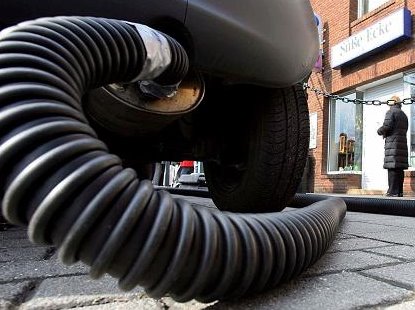
to give people a sense of the Holocaust by pumping lethal car exhaust fumes into a former synagogue and letting visitors enter one by one with a breathing apparatus.
I suppose everything worked out as planned: huge outrage, criticism, and a public debate about art, it's possible role in society and the way it can, should or does influence us.
The exhibition was suspended.

Here is my take on it.
1. I don't agree with the critics that claim Sierra's work is exactly what it claims to fight, i.e., "the trivialization of the Holocaust", as the artist put it. I don't think something becomes trivial just because you make a direct reference to it. Obviously, this isn't Disneyland, and nobody going in there must have made it light-heartedly. This is a very serious, heavy matter. When death is near, it is really too simple to discard it as "trivial".
2. Taking place in Germany, the work can be seen as a cleansing ritual, more than a gesture of rememberance. Many Germans I know never dared to ask their fathers or granfathers what they did during the war (Hans in his note to my last post notes the ever-present figure of the goo-bad uncle).
3. Part of the cleansing is certainly the aethetic aspect of the work. Walking in an abandoned synagogue is a strong emotion. Walking with a firefighter-guide makes it even more surreal.
4. The firefighter is a very strong element. It was misinterpreted by several commentators as the proof of how ridiculous an attempt at restaging the drama can be. Well, I think it rather shows that this is not a restaging. This is a work of art, and is to be treated as such. It tells a story which goes beyond itself. It is not about reliving the moment. It is, maybe, about the possibility of reliving the moment. About the power of a place. Authenticity - yes. But authenticity of a place, of a history, of an event. Authenticity of a gas and of our reaction to it. Of the precautions we take. Today.

5. If Sierra was actually after the creepy feeling that all this was real, if he wanted to "remember", he could have simply made a trip to Auschwitz. It is a horrible, horrible place. I'm still not sure if I think it is a good thing for it to exist. Its struggle for memory gets scarily close to a fascination with death, the same one that makes us look at an accident or listen to a horrible story. Yes, it makes us remember. But I'm not sure if the cost is not, well, some sort of a pornography, if you may, an indecent exposure of something that really should have been put to rest. Nonetheless, it exists - it's there to see for anyone unsure if his memory is correct, unsure if he has enough disgust for what people can do to other people. I don't think we need Santiago Sierra to remind us of that.
6. The difference is that Sierra made his piece in a gallery space. In a synagogue. In Germany. I am really tired of having Poland associated with the Holocaust (I think I mentioned it some while ago). This work puts the finger to the wound. Right where it (still!) hurts.
7. How pretentious to seek to evoke their horror and fear of death in such a cheap way! In a cynical game which yields no insight whatsoever. - says a newspaper.
For some time, Santiago Sierra has been asking one question: "What if it were you?". His works are exercices in empathy. They are often cruel exercices. In this sense, yes, they get cynical.
This reminds me of the famous Stanley Milgram, a scientist often accused of cynicism, who discovered that most people can be unhumanly cruel by creating simple conditions (orders coming from an authority) that made them do what they thought to be acts of great cruelty. Milgram was accused of turning people into murderers, as if they were toys to play with. Sierra is accused of "hurting the dignity of the victims", as if they were toys to play with. I really don't see how the dignity of the victims is being hurt. And, contrary to some of his other works, here Sierra doesn't actually use anyone, he doesn't turn people into something just (?) for art's sake.
8. What he does play with is memory. And guilt. The synagogue is the sign, it is what made the difference when the selection was made during the war, it was what identified the victims and what differenciated them from the others (the killers, but also the by-standers). Here, the visitor becomes at once the victim, the perpetrator and the by-stander, the observer. Being the art spectator he is, he cannot help but have a distance. At the same time, he goes inside, he participates. He repeats history. As a victim, or as a re-creator?
9. To me, this last question is going too far. And not because it crosses some line of decency. Because from what I can imagine and see on the pictures (once again: what can I imagine and see on the picture? how far can imagination get me?), the conceptuality of the work is simply unbearable. Bluntly speaking: it seems boring. It is the second work by Sierra that I find interesting as a concept, but have difficulty finding strong as an actual work (The first one was 300 tons). I really don't feel like walking through an empty synagogue with a fireman just so Santiago Sierra can make his point. And having a gas mask on would hardly change my stance.
But honestly, I think I still haven't figured it all out quite yet.


Saturday, April 01, 2006

By popular demand


Since the Richter quote seemed to bring some interesting questions (thanks Theo and Hans! I knew I could count on you!), here is some more fuel...

"pure painting is inanity, and a line is interesting only if it arouses interesting associations"


"The Photo Pictures [a series of photo-realistic paintings by Richter - Vv]: taking what is there, because one's own epxeriences only make things worse."
"Using chance is like painting Nature - but which chance event, out of all the countless possibilities?"

and finally, an apparently trivial one that I like a lot. Concerning an exhibition:
"The one thing that frightens me is that I might paint just as badly."

Wednesday, March 29, 2006

Gerhard Richter: the self-critical optimist


Of course I constantly despair at my own incapacity, at the impossibility of ever accomplishing anything, of painting a valid, true picture or even of knowing what such a thing ought to look like. But then I always have the hope that, if I persevere, it might one day happen. And this hope is nurtured every time something appears, a scattered, partial, initial hint of something which reminds me of what I long for, or which conveys a hint of it - although often enough I have been fooled by a momentary glimpse that then vanishes, leaving behind only the usual thing.

I have no motif, only motivation. I believe that motivation is the real thing, the natural thing, and that the motif is old-fashioned, even reactionary (as stupid as the question about the Meaning of Life).

- Gerhard Richter (20 February 1985)*

Several things strike me in the text above. One of them is how distant Richter seems from any sort of affirmation of having found something (he's so incredibly distant from Picasso's "I don't search - I find"!). It is much more than humbleness. It seems an actual feeling of worthlessness. And, all the same, persistent.
Another thing is the wonderful phrase: "a momentary glimpse that then vanishes, leaving behind only the usual thing". The usual thing. Great stuff.

Yet another nice touch is the identification of "the natural thing" with "the real thing". Coming from Richter, it sounds just out-of-this-world. I'm too tired to explain this, I hope you can think of what I mean.

*quoted from:


Wednesday, March 22, 2006

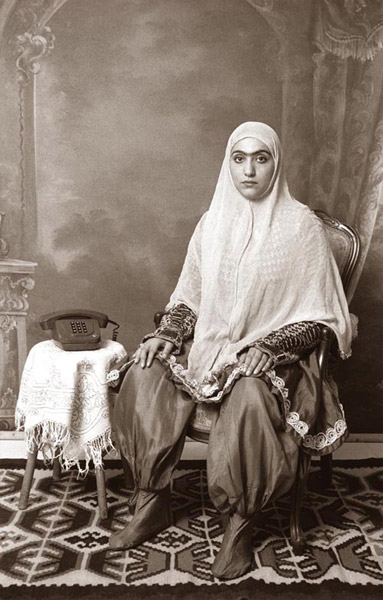
Two Iranian women by Shadi Gadhirian


(From the Qajar series)
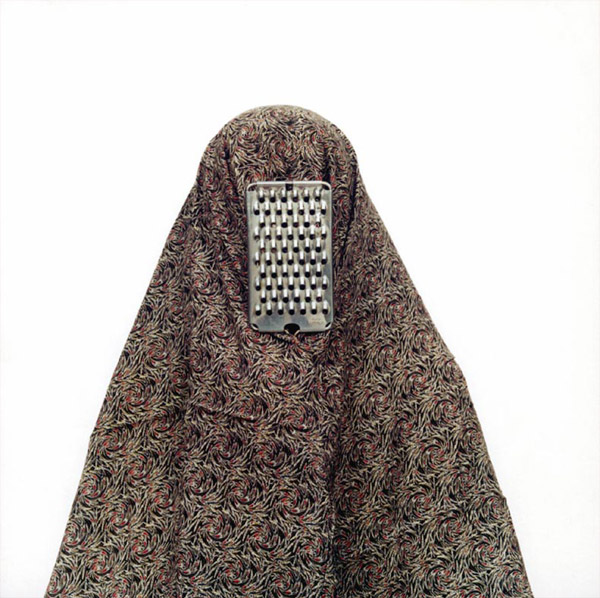
(from the Like Every Day series)
I am a woman and I live in Iran. I am a photographer and this is the only thing I know how to do. I began work after completing my studies. Quite by accident, the subjects of my first two series were "women". However, since then, every time I think about a new series, in a way it is related to women.

It does not make a difference to me what place the Iranian woman has in the world because I am sure no one knows much about it.

Perhaps the only mentality of an outsider about the Iranian woman is a black chador, however I try to portray all the aspects of the Iranian woman. And this completely depends on my own situation.

- Shadi Gadhirian

The two images above are my favorite ones from each of the series. The first one, because it's delicate. I find many of the other pictures in the Qajar series too obvious, too aggressive and thus too simplistic. The idea is explicit, and the contrast between modernity and "timelessness" looks more like a Hollywood time-travel film than a piece of reality. And that's fascinating - how
carefuly reality needs to be managed in order to appear as reality. In this particular picture, the time contrast fades to second plan. We have a duo - the phone and the girl. The phone seems to somehow upstage the girl. Its silence is stronger. It attracts the girl without her knowing about it. We know she is waiting for a call, and that is the reason for her being serious. And only now, after "reading" this, do we realize we exist in a strange time zone, the picture is old, very old, the girl is "timeless", and the phone is the only connection to... us. At the same time, it is a somehow outdated phone, one we rarely see around us (depending where we live, of course!). And once again, time is suspended: is it the local object-time? Or is it really going back? When is the story being told? How far are we?
The second picture is part of an entire lot of kitchen appliances. Do I need to spell out what it does? I like this particular objects, because it hurts. In this context, it could very well be an instrument of torture. Isn't it?


Snail on Zebra

This is apparently a fairly old video, but I have just received it now. Hail to street-wise grassroots performance!
(Click on the image above) The video is apparently by one Johan van Hensbergen.

I have been desperately trying to make the Fluxus Films work on my computer, alas, to no avail. Hope you have more luck!

Jack Vettriano as wall decorator

"I just consider myself a trader. I take my goods to the marketplace and try to get the best price I can."

The greater glory of art doesn't come into it, he confirms. "That's not why I paint," he said. "It's wall decoration for me, I don't regard it as this big meaningful thing. My subjects are men and women getting off, that's all. Mind you, some people don't think sex is serious, but I happen to think it's terribly serious."

from an interview with Jack Vettriano
(via)


Saturday, March 18, 2006

Tuesday, March 14, 2006

The Search for the Perfect Dress


Burkha, by Spanish designer/artist Alicia Framis, is made of Twaron, also known as kevlar or aramid fiber, an ultra-resistent material that is bullet-proof, but also resists flames and dog bites. This is to protect its wearer in dangerous extreme right-wing neighbourhoods where violence against immigrants and religious minorities often takes place.

Looking at the picture, Linda Zacks' question "Burka or Bikini?" comes to mind.
Why does this answer scare me even more? Am I being way too conservative? Besides being an artistic work, it is also a social statement. Yet, somehow, it seems to provoke both sides, the islamic culture and the "Western rationalism". Yes, I think I like this chill down my spine. There is something wrong with the picture, because there is something wrong with the sudden proximity of tradition in its most limiting sense and modernity in its most limiting sense. Seen from the point of view of the other, they both might seem ridiculous. And they could, if they wished to, listen more carefuly to who the other one is. On both sides.

We cannot escape having divided personalities. Having our culture invaded by the culture. I always tend to think of the times of the Roman Empire, when latin invaded the world. The ridiculous nature of civilization is so clear in these periods of overcoming, swallowing... A recent lecture, Coetzee's Waiting for the Barbarians, comes to mind: are we better because we wash twice a day? Are we better because we have a method for writing down our history? Because we own what we call rationalism? How many of us own it, to be precise? But, if we accept the "barbarians", if we embrace the other, either in our tolerance and/or in our wish to enrich ourselves, who are we? And if we are the other, and decide to take some of this otherness in parantheses, as the vast majority of religious people do today, as do people from influencial cultural backgrounds, who are we then?
Double-headed monsters?
Rosemarie Trockel, Schizo-pullover (1988)


About Performance Art (I)

In the days of my blogsilence, I went to Coimbra, where I was invited to talk about performance art at the Santa Clara Gallery. I spoke about how performance art has changed in the last few years, and why it has been so often practiced by minorities. Obviously, I wasn't talking about anything one can call performance art, but rather, about certain currents I see in performance.

My idea is that, beyond the fact that it's so ill-defined it can be practically anything, and so "whatever you do, it works", several more specific characteristics make it a great means of expression for groups with a strong sense of identity (as is the case with minorities).
  • First, its rebellious nature. This is probably the most commonly known quality of performance, which, in my eyes, has done it just as much harm as it has publicized it. True, it puts performance art on the side of the underdogs, giving the "rebels" a chance to speak up. But how "up" is it? Who listens to them? Other performance artists and a tiny crowd of admirers. At least, that was the case with performance art (as it was defined by those who did it and saw it) for the past decades. A scandal is good every once in a while, but constant scandals are simply not a scandal any more. They tend to be tedious, long events where the suffering and pain of the performers brings suprizingly more embarrassment than empathy. Nonetheless, scandal, if used in a fresh way, can be good. It also emphasizes the difference, the otherness, the identity of the other, thus allowing this other to appear as an actual player.

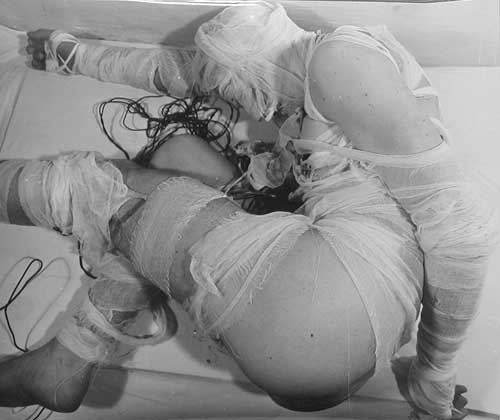
Rudolf Schwarzkogler, Aktion (1965)
  • Performance art looks for communication, but not through a mimetic de-monstration. Instead, it puts an accent on the very being, looking for the communicative aspects of reality. This can mean simply performing something, as in executing an action (see Althamer's Film), or it can mean looking at being in an objectifying way, like Vanessa Beecroft or Santiago Sierra might be doing.

What may come as a surprize is that this objectification can actually get us closer to the identity of the people. We feel empathy for Sierra's performers; we somehow refuse to see pure objects in Beecroft's girls. We feel obliged (yes, a moral category!) to project on them a presumed humanity, to see them as people, to ask ourselves about them, about their position, role, about why they are doing what they are doing and why we are doing what we are. This brings another point,

They all share a space of intimacy, of sharing, of actually living together. This is a game of acknowledgement, of personal limits being overcome. It is creating a space where it is difficult for me to say something is simply a "good" or "bad" show, because I get involved (remember the Bill T. Jones case?). I don't need to actually be a "participant", i.e. I don't need to be performing an action, but I need to feel that the bond between me and what is happening on the "stage" (or in the "framework", to use an excellent term by the great Irving Goffman), that this bond goes beyond a show.


Monday, March 13, 2006

Post-Private Post


Swipe could be seen as anything but art. It seems simple: the bar has a special ID card reader, just like in a grocery store, or rather - a police car (in the U.S., that is). It allows the bar owners to see a lot of things about the customer. If it sounds to you like a sci-fi film, it's probably because you don't live in the U.S. So far, it is nothing more than an ID-checking system turned marketing device. We've heard about it, we might have had the chance to see some of them, but that's about it.

But this time, there is more.

Many people are unaware that personal data is even encoded on their license, and, if they do realize this, they probably do not know exactly what information is there. SWIPE brings attention to these practices and enables people to see exactly what is stored on their mysterious strip.

SWIPE also illustrates how this information is used and why businesses and government crave it. Our hope is to encourage thinking beyond the individual self ("I do not care if a bar database has my name and address and time of visit...") toward understanding databases as a discursive, organizational practice and an essential technique of power in today's social field.

You can also invite SWIPE to your private reception. Here is the "performance" that will take place:
People who approach the bar in search of a refreshing drink will be asked by a bartender (SWIPE member) to show their driver's license for age verification. The bartender will look at the license and place it in an automated, scanning device. While the customer waits for his/her drink order, the SWIPE cash register performs a technique called computer matching based on the driver's license information. Several minutes later, the person's name is called and he/she receives their drink with "receipt." The receipt is a SWIPE compiled data image consisting of the data encoded on a driver's license augmented by online searches of data-warehouses and/or demographic analysis generated by SWIPE custom-designed software.

Basically, you get a fairly detailed picture of yourself. And if you think it matters that it has a few mistakes - it really doesn't. The data will soon be tested on you anyway. You can also access the internet toolkit, hosted by Turbulence. I found out through it that the data I regularly give away for various reasons (studies etc.) are worth $54.18.
This is a very strong initiative, and one of its creators, Beatriz da Costa, seems to be gaining momentum (she will appear in the San Jose Interactive City festival). The worst part is, this is no conspiracy theory. It is describing a simple fact, something that has been taking place for some time now. Privacy is actually at stake. And if you don't care, you might just not be getting it. Quite yet.

Tuesday, March 07, 2006

Ernesto Neto's latest fluff


Ernesto Neto's Humanoids are my favorite piece of his. Most of his pieces are somewhat creepy. Yes, there is light in them, and a playful spirit, but there is also something sleazy, the smell is often intensive, and they seem distant, almost inhuman. It is not the case with these funny, soft creatures. They have a wonderful, light spirit, while remaining somewhat enigmatic and out-of-this-world. I wish they were available in stores. Wouldn't that be an amazing armchair? Design and fine arts couldn't be closer...
The work is part of a whole "labyrinth" of forms called the Malmo Experience (you guessed it, it's exhibited in Malmo).

Monday, March 06, 2006

A game for those who like to take it slow, get a little confused, a little charmed and above all, who find there is magic in the keyboard.

Friday, March 03, 2006

Pretty plagiarism?


As much as I like this picture by Nicoletta Ceccoli, which adorns the cover of the last Born Magazine, it seems like...well, I'll say it - plagiarism. The Lithuanian-Polish artist Stasys Eidrigevicius painted incredibly similar pictures some 30 years ago or more, in a children's book I have somewhere in Poland. Here is an example of a similar book, though slightly different.
The pictures I'm refering to show a boy with his head covered in birds that fly away out of it. The book is a poem by Joanna Papuzinska about a boy that instead of having toys or adventures has ideas.
Even the birds look similar.
Then again, Bach's copy of Vivaldi's violin concerto was apparently a great tribute. How are we to judge?

Monika Hoinkis: humanizing the object

Why is the metronome only listening to its own rhythm? Can't it ever listen to me? React to me?
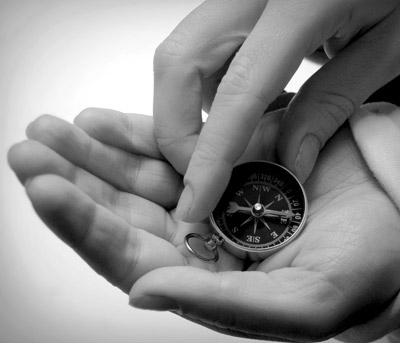
And this compass? Why should it always point to the North, ignoring me completely?
What if it actually lived with me? Monika Hoinkis decided to live with the objects and see if they will also accept to live with her. And they did.

The compass points at the person holding it. The metronome reacts to physical presence. Even water vibrates to... you guessed it, to your own heartbeat.
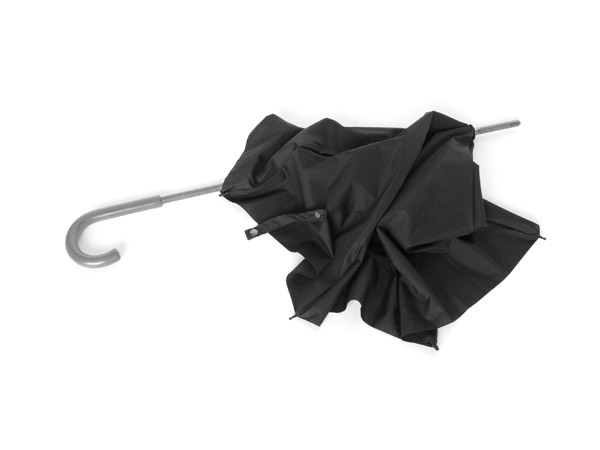
And this umbrella? Come on, you know you want it. Give it a hug. It's the only way to be well protected anyway.

See the whole Living with Things series.

Thursday, March 02, 2006

Women by women

Billboard (2003) by Heta Kuchka

Billboard (2003) by Liv Carlé
Part of the Billboard project www.women2003 :
From 23. March to 4. April [2003] one hundred and two Scandinavian female artists will present their own personal and artistic female image in the public space ? entering a dialogue with the images created by commercials. (...)
In that way the new female images created by this project will form a solid and diverse contrast to the monotonous representations created by the commercial market.
What is strange is how many of these works (the ones above included) define the woman through her relation to the man.
Both these images are disturbing. And they say somewhat similar things - the fear of rejection, the question of being appealing or not, the scary idea that the author, a woman, is completely wrong, just because she is herself.
And while it's supposed to question our values as men (and women who accept this), I'm not sure if it doesn't do exactly the opposite, provoking us to answer, "Get a grip on yourself girl! If you can't make him appreciate you for who you are, if you can't gain respect, if you get a guy that sees you as a toy, you better look around. There are plenty more of us, you know".
But, look at it from another point of view. The two works I present are part of a series of actual billboards put in and around Copenhagen and Malmö. They are not as much a statement, as they are an answer. They laugh at the myth. At the plastic imagery we know all-too-well. And if that answer tells more about men than about women, it might be giving us a hint about the images it aims to reply to.

LinkWithin

Related Posts with Thumbnails