Sunday, November 22, 2009

The Song Is You

It might seem innocent.
Yes, this is innocence. It is the purity of what happens when the postmodernisms and the camps and the sooavantgardes have made their statements and played their anti-tunes, and yet, we are still there, trying to listen in to that something special.

Call us romantic. Call us Those Who Couldn't Stand The Progress And Stepped Back.Retrograded, taking the easy way out, exploring the (music's, world's, history's) feedback.


Yet feedback is not the sound that comes back to its source. It is not the echo. It is the echo used as an input.
Thus, what you call feedback is the mere beginning, the source material of the process of creation. As the world comes back crumbling to the imperfection of our ever-childish senses, our feeble gestures, breaking through our inherited self-irony, make things possible. Better, they give us back the light.


Too light? Too naive?
Would you prefer this?


The Gospel was right: The meek shall inherit the Earth. Actually, they've inherited it already. Along with the self-irony, they took what was most precious, and what many deemed lost - the damn aura. Yes, the damn aura still shining and glowing through all the mechanical reproductions. We still want their bloody flesh, we still want to know this is where it's at, right here, between the stage and you, between the song and you.

x x x
All this crossed my mind when watching the brilliant The Song Is You festival at Powiększenie in Warsaw recently.
The song that stayed with me the most was simple.
Here it is:

Do you get it? Beyond the gorgeous lyrics, can you feel how it was, listening to it in the club basement, with the grand piano behind Momus, the lights, the weekend dying away? Or can you imagine it? How different is the song you hear from mine?
More on the festival here. Don't miss tonight (12.03), the last part of the festival, with Kyst and AU.


Sunday, November 15, 2009

Past Present

Take a look at the pictures by Roger Cremers. The series, which won an award at the 2009 World Press Photo, is called Preserving Memory: Visitors at the Memorial and Museum Auschwitz-Birkenau, Poland, 30 April-4 May.


No, I will not be writing about how the ever-present cameras turn us into monsters. Or about consumerism versus culture.
What interests me here, to start with, is how we position ourselves in relation to the past.
What is given to us is not merely a luggage - a heritage that is like an object. It is an ever-eroding landscape. And each person has her own map she may or may not use to rebuild it, or rather, to build herself into it.
Watch these bodies. These figures. Watch how they open a dialogue they are not aware of. Watch how they become, that's it, a sign.
Maybe the most dramatic is the last one, the young man lying on the ground, his hands close to his face. Forget his camera. Now, what do you see?
Or maybe the most dramatic is the first, black figure, that is watching birds through binoculars, or a plane, or he could almost be shouting a friendly greeting to someone standing on the roof... were it not the seemingly anonymous bricks behind him. Were it not our maps. And now, with your map, what do you see? Who is hitting him? Shooting?
Or rather, what is he, what are they protecting themselves against?

What makes a sign a sign?
When does it signify, lead to the signified? How does the arrow gain its shape? How is it born?
How much of these vectors is rooted in us so deeply, we spell it out with every word, unknowingly?

Take this much less spectacular project by William Boling, called Never Gone. Boling took photographs of the places in Atlanta where the Battle of Atlanta occurred in July 1864.


So what makes a sign a sign?
When does it signify, lead to the signified? How does the arrow gain its shape? How is it born?
How much of these vectors is rooted in us so deeply, we spell it out with every word, unknowingly?

How To Win An Art Contest In One Easy Step

Make one.
Tom Polo created the 2009 B.E.S.T. Contemporary Art Prize for Painting contest. The criteria were typical of the art contests we know. Except for one small point, which stated:
eligible entrants are artists born on the 1st February, 1985 and named as 'Tommaso Polo' on their birth certificates.
The exhibition of the finalists (guess who?) is taking place at the MOP gallery in Sydney.
The winning work, by - you guessed it - Tom Polo, is called Continuous One Liners (Young People Today).Possibly many of my dear readers are thinking, we've had similar ideas, but they were too childish to execute. Maybe the most seductive part of tricksters is that by putting to life the silliness we only imagine (or think we imagined), they at once make it more serious and much more ridiculous.
You can find an interview with the artist at The Art Life.
Why B.E.S.T.? Because Everybody Still Tries.


Tuesday, November 03, 2009

Anonymous. 3 works by Armin Rohr


I can't get these pictures out of my head.
Especially the last one is mesmerizing. Is it peaceful? Mysterious? Haunting? Creepy? Brutal?
The mass in the first two paintings that makes up a threatening, or at least disquieting block, is here replaced by three distinct figures. The space is neither claustrophobic, as in the first one, nor agoraphobic, as could be claimed about the second (notice the ceiling moving up above the horizontal line that "closes" the picture). In the third picture, the space is abstract. It is the water we often feel is the closest to the sky. So what's the matter? Maybe it's the skyish space combined with the strokes, the juicy, dripping pinks that get feverish in the center? Maybe it's the unfaceness of these faces? The ghost should be ephemeral, translucid. Yet here, the ghosts are opaque. They are thick with body. And moving in.

All works are by Armin Rohr, found on his blog.


Sunday, November 01, 2009

If You Want To Cry

...cry to this.

My Mother, My Son by Mary Frey

And another one, less obvious, but no less gorgeous - Bathroom Landscape:

Every once in a while the question comes back lurking: are there things that are not to be shown? Or rather: not to be worked at? Do you imagine this - a woman standing in the room with a camera, waiting for the right moment so she can take a picture of her son carrying her mother? Hold her up just a bit honey... Just a little more...
And yet, this is one of the most touching pictures I have seen in quite a while.

(via)

Zoonoia

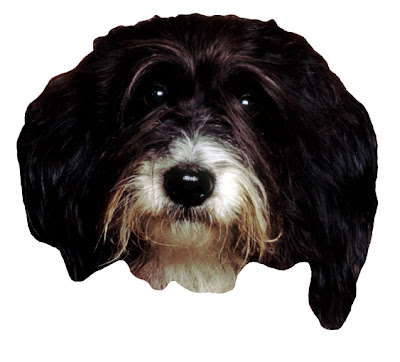
From the crazy guys at Koerner Union comes the most original dog portrait of 2008:

...and the most unappealing digital album of 2007 - Ready Made. Which is also an accomplishment of sorts.

Tuesday, October 27, 2009

In A Sentimental Mood


Sonnet 44
If the dull substance of my flesh were thought,
Injurious distance should not stop my way;
For then despite of space I would be brought,
From limits far remote, where thou dost stay.
No matter then although my foot did stand
Upon the farthest earth removed from thee;
For nimble thought can jump both sea and land
As soon as think the place where he would be.
But, ah, thought kills me that I am not thought,
To leap large lengths of miles when thou art gone,
But that, so much of earth and water wrought,
I must attend time's leisure with my moan,
Receiving nought by elements so slow,
But heavy tears, badges of either's woe.

(Shakespeare)


One more thing: The bone in the film is a wishbone:
The wishbone, known in anatomy as the furcula, is a sternum bone found in birds which is shaped like the letter Y. It is used as an attachment point for the wing muscles. It is so named because of a tradition: Two people pull on each side of such a bone, and when it breaks, the one who gets the larger part is said to have a wish granted.

The mechanical sculpture in the film is by Arthur Ganson. Some of his stuff is really awe-inspiring. Check this Machine with Artichoke Petal #2


Of course, it may bring to mind other art machines (Rebecca Horn, but also manyothers), but what I really appreciate here is the simplicity. Modest art is something to be cherished. It also reminds me of some of the musical experiences by the Portuguese musician Nuno Rebelo:


Even the really simple ones are really something: Machine with Chinese Fan


Is it kitsch? I don't care.
(via)

Monday, October 26, 2009

Workingg

Just so you don't think I'm ignoring you - check out some great projects by Marc Kremers:
  • As found, a site with images found on the net... Fantastic.
  • The wonderfuly anarchist Tex Server.
  • And some of Marc's animations can be found here.


Saturday, October 24, 2009

The right and the rights

So how was it for YOU?

Not all of Robert Grigolov's work convinces me. Some of it seems like simple tricks pour épater les bourgeois. But isn't part of the fun about discovering the value something has for you when taking out of a context which isn't necessarily one you appreciate?

Why does the above installation have the title Dollar Bill? I don't know. I have some ideas, but I don't think I want to follow them. And, just as Daniel Pennac's 10 Inalienable Rights of the Reader, so any spectator has similar rights, among them, to decide arbitrarily where the work begins and ends for her.


This doesn't need to mean any sort of glorification of ignorance. However, it does accept it as part of the deal. After all, the spectator is no less free than the artist, is he?


This should be a very obvious question. Aesthetic relativism is something seemingly accepted. Yet the contemporary art world seems to specialize in "right" ways of looking at its creations.
Anything goes - yet there is still plenty of exciting space for dialogue. Tastes are indeed something we discuss and shape, aesthetic experience is a beautifuly shapeable thing. And yet one of the most difficult things is to stay within the play of common value-seeking and exploration of personal experience, and not move into the discourse of competence, the universe of authority, which might sustain a big chunk of what the contemporary art world is about, but is hardly enjoyable for those of us who like their artflesh stupendously raw and intimate.
(via)

Wednesday, October 21, 2009

Watch your back


Oh what jealousy of the physical difference! Of the outcasting cast out in flesh! Oh how simple the definitions then become. How meaningful in their ever-presence. What sort of a tragedy can there be when its shape is nothing? How do you give it shape? How do you translate it into something it is not?

All pictures are by Risk Hazekamp.

Wednesday, October 14, 2009

Art after commerce

Here's a recent work made by Julius Popp, a German artist:


And here's a commercial product present since 1989:


Classic questions:
How much of the value is the originality of the project?
How much is there left for the concept? The execution? The richness of the universe that is being created? The "art codes"?
The bluff?
Should one stop/diverge a project upon realizing one is following another's path too closely?
This latter question is quite recurrent among many of the artists I know. Some opt for stopping, while others simply don't let go of their toy. After all, they say, isn't it always mine in the first place? Unintentional plagiarism? So what? If you focus on what you are, on your own path, shouldn't it always lead to an original work? In the best of possible worlds?

Monday, October 12, 2009

The Wild Things Are In Forts


Some of my favorites from the Wild Things' Forts contest by Booooom, where you can send in your picture of a fort....
Here's the explanation:

Where The Wild Things Are is filled with references to building a world out of things from your everyday life and that’s exactly what we want you to do!

We want you to create a fort! Use garbage bags, tree branches, tablecloths, prosthetic limbs, wood, gold, whatever you got!

Snap a photo, and email it to me, here.

Winner gets a “Wild Things” Edition XBOX plus a magnificent bus shelter-sized Where the Wild Things Are poster not available in stores!

Contest ends next Monday (October 12th), so get on it!


Wednesday, October 07, 2009

Saturday, October 03, 2009

The Expecting Creator Of Matter

Watch the edges; yet another birth, another coming-to, another attempt at elucidation, lucid, try lucidity, for a change, just watch the edges, and also, try to aim at the opaque, but where's the opaque in the translucid, and how, how does it


Elucidation: an act of explaining that serves to clear up and cast light on. The splendid, harsh ambiguity of words, the clustering of them, the annoying coming-to, they do not leave us they do not, they do not leave us, an act of explaining, take that, an act, ex-plain, serves, clear, clear up, cast, cast, cast, light. On.


And as it is happening, you watch it take shape, this thing, this event, this work, this thing-in-work-in-process, which is you in the stupidest of senses, you have been feeding it and yes, you were the, the ur-text, but what with it, the bone, the rib, the biblical Eve, so clearly not you, going elsewhere, as you watch


All works by Loris Cecchini.

Friday, October 02, 2009

After a conversation with AB

Apparently, the National Railway Workers installed a handrail on Richard Serra’s sculpture in Duedingen, Switzerland. Why would anyone want the autonomy of the artist?

(via)

Thursday, October 01, 2009

Polly Morgan's choir


What is this choir of possibilities you offer me? Where can it take us? What tragic song may be ours, what sort of future may a non-future contain? Then again, isn't it just a question of measure? Stop here. Stop here. The still. The gesture, frozen, with the impossible life no less possible than any other still. Still. Hold it more gently. Don't make your hand into a fist. Let them be flowers, let them be flowers, singing flowers, watching singing flowers, for just another, for just another still.

You can purchase this exclusive Polly Morgan print at murmurart. If you dare hang this on a wall.

Monday, September 28, 2009

In Hiding


Works by Janine Antoni (the first one is a sculpture - a cast of the artist - and not a photo of a performed action, as is the case with the second one).
And as a bonus, a work by her called Umbillical (2000), made of a "sterling silver cast of family silverware and negative impression of artist's mouth and mother's hand".


Saturday, September 26, 2009

Do You Believe In Magic? Grospierre vs. Radziszewski

a comparison of Karol Radziszewski's To Pee In a Bun and Nicolas Grospierre's Kunstkamera

The two recently* opened exhibitions at the main two contemporary art centers in Warsaw – Zachęta and the Contemporary Art Center – have some clear similarities.

Both exhibitions are witty, explicit dialogues with art history. They both play on the distance that separates contemporary art conventions from what has been somewhat recklessly left behind. Radziszewski exhibits works hidden in the depths of the national gallery’s archives. Some are excruciating to look at, others are curious discoveries or brilliant works. Grospierre goes back to the format of the Kunstkammer and does what he does best – plays with it.

They both focus on the structure of an exhibition, and make it an essential aspect, a sort of a meta-work which goes far beyond the classical idea of curator and uses the ambiguity of this function to the utmost. It is impossible to say where the curator’s role stops and the artist’s begins. This goes far beyond the inclusion of the curator’s own works in the exhibition, or his manipulation of the showing. We never know when the appreciation of the shown works is genuine, and when it is ironic. And because of the artists’ works being part of the selection, the self-irony is, as always, disarming.

However, each artist enacts the role of contemporary art trickster in a different way. Beyond questions of scale, budget and context of production, the two exhibitions are at two opposite sides of an old aesthetic debate. They present two different approaches to the question of value in aesthetics. But first, let me give you a brief description of each of the exhibitions.

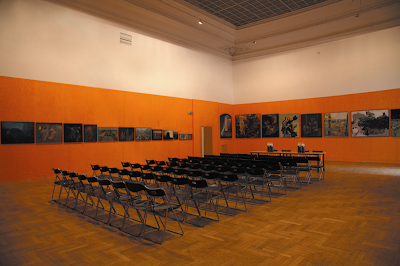
Karol Radziszewski’s exhibition To Pee in a Bun, is grandiose. It is a personal take on the collection of Poland’s most renowned and respected public gallery of Modern Art (charmingly called The Encouragement for Fine Art).
In it, he acts “merely” as curator, and also as one of the numerous exhibited artists. Here is what the curator had to say in a conversation with himself as artist :
C: Curators are the ones who make the artists conscious of
‘what’ they have created and ‘why’; often, they also manipulate the
works being displayed, creating their own narratives from pre-existing
works, at the same time disregarding their previous context.
A: Like you did in this exhibition?
C: Yes. (laughs)
A: Why?
C: I treat other artists’ works as elements of a larger whole, like
tubes of paint, from which I have to squeeze out colours in order
to paint one complex painting.
A: That’s a very colourful metaphor . . .
C: Thank you.

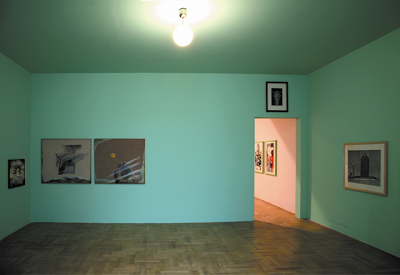
We could say that Nicolas Grospierre creates a similar procedure of remixing curator and artist when in the Kunstkamera installation, (which is the size of one of the smaller rooms in Radziszewski’s exhibition), he hangs mainly pictures of objects and photos created by other people, and signs the whole as his piece.
Yet the vectors, here, point elsewhere. Instead of spreading the works and opening, if not exploding, them, he seems to move inwards, closing the space and folding it yet again. Upon entering the "room", we discover a game of images reproducing images reproducing the same space with other images. The game goes on, like a play with mirrors, ad infinitum. The "meaning" is still ambiguous - yet it concentrates, thickens, moves toward inhabiting the space instead of abandoning it.


So what does all of this have to do with philosophical debates?

In an article published in 1936, Stanisław Ossowski, one of Poland’s most notable thinkers from the famous Lvov-Warsaw school of thought, argued against aesthetics understood as the “construction of value systems”. The generalizing of arbitrary aesthetic feelings and opinions to the level of theory should, in his opinion, give way to a sociological perspective on art and the aesthetic, one which would embrace the richness of opinions and points of view instead of imposing them.
This bold proposal was answered the same year by another great mind, Henryk Elzenberg, who argued that no matter how weak and prone to error, our aesthetic judgments remain anchored in value systems that can and should be discussed – as we cannot speak of aesthetics without referring to value, and values are open to discussion.

To put it bluntly: in Radziszewski’s exhibition I see Ossowski’s distancing from aesthetics as a system of values, while Grospierre’s installation follows Elzenberg’s ideals.

These are really two different ways of approaching the world.

Ossowski claims that any discussion about aesthetic values comes down to a power struggle. And this overpowering does not go through a sharing of enthusiasm or disgust, but goes through the attribution of value. Why? Elzenberg explains:
Apparently [the value-based aestheticist] lacks qualifications: he does not have the authority, or the suggestive strength, or the capacity to contaminate others with his feeling. And he is overfilled with the will to rule. Thus, he tries to convince the victim that if this victim feels the same things he does, the victim will be right, he will be somehow objectively correct; and he will be wrong if he dares otherwise.

Hence the need for distance.
It seems Radziszewski claims it on every single step. On one hand, his collection is a moving away from an engaged position, it is rather a questioning of our aesthetic values, of their ever-astounding relativity and apparent insignificance. Who are we to say that this is pretty, and this isn’t? How are we to judge the works that a mere 30 years ago were judged outstanding, while today they’re hidden away in a museum cellar?
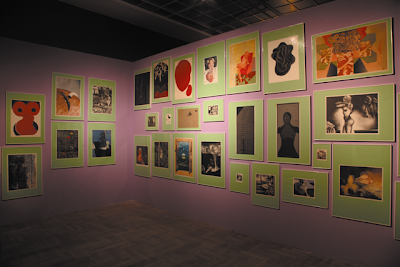
On the other hand though, Radziszewski’s approach differs from Ossowski’s philosophy in one respect: being an artist, and not a social scientist, he does not feel the need to eradicate the position of power. To the contrary, he exposes it by exploring it to the fullest. Why bring a porn film into the gallery? Because it’s shocking, and attracts audiences. The aestheticist’s position allows him to create values arbitrarily:
A: You’re a curator — does that mean power?
C: Absolute power! (laughs)
A: Most people believe curators are unfulfilled artists.
C: I think that does hold true for me. Besides, to quote Krasiński
yet again, ‘Art is too serious a business to be left in artists’ hands.’
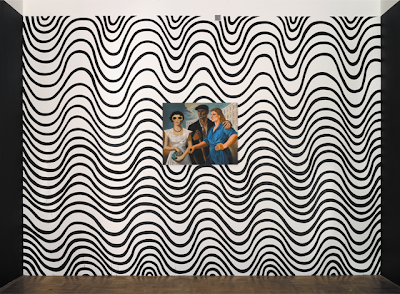
Grospierre is at a very different point. He does not feel the necessity to question everything – art history has done it sufficiently. Instead, he looks for ways of exploring the place of art today while not undoing it all yet again. Romantic? Certainly. It is a self-ironic romanticism, one that takes great effort in presenting itself as distanced and eye-winking. No wonder Grospierre cites Italo Calvino and Borges: this is the romantic universe that leads the battle for saving beauty. It is not, however, an intuitive aesthetic experience kind of beauty. The Kunstkamera is all about unending layers of initiation. It is a dive into the possibility of image, the possibility of the reflection of things, of some sort of hidden and evolving harmony between the object and the subject.

It reminds one of Heidegger’s conception of art as a window to some other realm we can in no other way describe. Here, this realm always crosses first an image of the reality we know – and so, we never know if this is the level of work-of-art, or it is only a description thereof. Fittingly, the exhibition flyer (a photocopy with clear photocopy marks) explains it all, and more. It seems to impose its vision of the work before we even get to see it.
Take, for instance, the “Trophies” section.
Trophies represent four dog muzzles, belonging to the commonest of mongrels. Bolek, Majka, Eryk and Gucio are four doggies among thousands. In the old Wunderkammer we would find extraordinary or unique natural objects: the horn of a unicorn, huge crystals, stuffed reptiles and other monstrosities. The idea was to show nature in the most surprising forms. Today the world seems devoid of the mysteries and much simpler than in the sixteenth century: the monsters disappeared from biology books. Might it be that the world is less poetic, more prosaic? I don’t think so. Even if science discovered many of nature’s secrets, for me poetry and mystery are still present in nature – we can find them in the most common species, such as house dogs.
The two positions can be called “metaphisical” and “positivist”. Elzenberg’s metaphisicist is
quite aware that there are hundreds of traps on his way; that his individual chances of error are bigger than his chances of winning; he feels that his results are to the highest degree uncertain, endangered by others’ critique and by his own. He feels the constant risk. Yet this risk is also his joy, since, as a psychological type, he has in him – and indeed needs to have – a little bit of a man of adventure and his attitude towards the “positivist” is somewhat like the attitude of a sailor that knows he can drown, towards the landlubber, who has no such fiercely unpleasant risk awaiting. It gives him a sort of satisfaction, but that is not what decides about his behavior in terms of acquiring knowledge; the decisive factor is that he does not want to drown. And that is why he is first and foremost careful. The “Metaphisicist” – or rather, to put it in more serious terms, the valuing aestheticist – knows well that his subject is unclear and unattainable and that what he discovers in it flees any adequate descriptions. Thus, although he is a sui generis racionalist to start off, it is nonetheless easy to discover a trait in him that is the contrary of a strict rationalism: the tendency to treat concepts and judgments as merely a type of highly uncertain symbols of a reality that resists human thought. Thus, he will not suggest that the chiaroscuro in which he sees the thing is full light, nor will he bond himself till death due him part with this or that linguistic formula or even this or that discursive elaboration of his intuition. He – yes he! - has something in him of the spirit of empiricism, as he understands his moving into the subject as a multiplicity of attempts and returns, as the entering in contact, as a progressive bonding with reality. Hence, he has the quality of being critical towards his own achievements, he consciously softens the edges of his statements, and is ready for changes and corrections, and, generally speaking, is moderate and more moderate even.
So do you believe in magic? In the aesthetic wonder of art, that keeps evolving beyond all expectations, that is in some strange way always related to beauty, and maintains some sort of objective common ground, some platform of shared values?
Or did the whole building of aesthetics collapse, leaving us in a void where any new creation of value is so easily ridiculed, art may at best be looked from a great distance, with an ironic, witty, sensitive yet unaffirming stance?

I must say I prefer Grospierre's installation: it's discursive and communicative, inquiring and playful, desperately searching for beauty, or maybe: aiming at beauty. This is a work of a believer. And although I'm not exactly a believer, I can repeat after one of my favorite characters, Samuel Hamilton: I don't really believe in it save that it works.

*It took me some time to write this... and tomorrow is the last day of Kunstkamera! Hurry if you want to see it.

LinkWithin

Related Posts with Thumbnails