Magmart | International Festival of VideoArt | 2nd edition
"Is now starting, till February 2007, the 2nd edition of Magmart | video under volcano, international festival of video art.
The festival is a production of studio tad, with partnership of Casoria Contemporary Art Museum, GenomART and Computer Arts magazine (italian edition)."
Enrico Tomaselli
festival staff
info@magmart.it
http://www.magmart.it
Skype: MetaArt
Monday, October 16, 2006
Videoart contest
Sunday, October 15, 2006
Aram Bartholl is playing with your life
Aram Bartholl, First Person Shooter
Pretty self-explanatory. Among Bartholl's projects there are several ones playing with the idea of an "online" gaming world. It is all light-hearted, smart material. Taking oneself just seriously enough, but for heavens' sake, not too seriously! See, for example, this charming film from the WoW project:
(if nothing appears, see here)
Notice that the first work shown here seems to be created by someone protesting against the violence in video games. But discovering the artist's portfolio makes us realize he is rather someone who has been working (among others) on the crossing between real life and the gaming reality. This hides a very interesting and delicate issue: the spectator usually expects the artist to have some sort of an agenda, a declared ideology that he would be pursuing (here, it could be pacifism). Instead, artists often work on a vocabulary, a particular language, rather than an idea(l). Matter forms itself in a certain way and the artist, like the first spectator, discovers its dynamics and its possible readings. Especially in the world of theater (though not only), this makes a lot of people uncomfortable. The idea of an artist as someone entirely in control, like some mad scientist who knows what he is inventing (!) makes it difficult for many artists to assume: this is what I discovered, I'm not sure what it is, but I like it, and I hope we can all find out more about the potential vectors of this...thing. As Goat Island puts it, "we have discovered a performance by making it".
Wednesday, October 11, 2006
Since we're on the light side
De Marinis is also known as an electronic music composer, and a recent installation of his was featured at we-make-money-not-art. Personally, I like this one more - it's technically much simpler, but to the point.
Also, I really wouldn't need any music, and think it might fit better in the middle of, say, Lisbon, where the summer heat would be enough of a motivation to dive into the rainbow - no need for umbrellas or such. I know the umbrellas serve as speakers, but it looks like more of a gadget than anything else here, there is something wrong about it in this case. Maybe it's the isolation from the rainbow? Or maybe umbrellas simply have a sad relation with water.
(via)
Tuesday, October 10, 2006
Carsten Höller at the Tate: Are we having fun yet?
A slide, in art, can hardly be a slide, can it?
There are several reasons why this slide can't just be a slide. 1) It is set at the Tate Gallery Turbine Hall; 2) It is considered a sculpture by its author; 3) It is considered a sculpture by the art milieu; 4) I feel like seeing it as something else (a sculpture, a performance, a social experiment, an undefined set).
Each of these reasons has an entire theory attached to it. Points 1) and 3) are closely related, they belong to the "institutional definition of art". Points 2) and 4) are both part of the "subjective definition of art", with some important differences.
But why bother defining? What does it matter? Can't we just enjoy the ride?
It seems only logical that the installation be presented at the Turbine Hall. This is another turbine, a machine that we fuel. By forcing ourselves to forget the conceptual grid, with its heavy chunks of grey cell mass, and diving in. Only then does it seem possible to believe in the
utopian vision of a world in which slides are a means of getting from one place to another, an alternative to stairs, lifts and escalators.And only then does this whole affair appear as fun, appealing, and something that actually works, rather than as a funny but futile game. (Unless, of course, we accept art as being futile anyhow.)
Is there a difference between this slide and any other slide in the world? Any substantial difference? Not to me. Which doesn't in the least take away the value of this particular work, as art and as slide. Because thanks to this one, I will cherish watching slides, and sliding, even more. It brings a new starting perspective, like a paradigm that allows to see things with a previously unfelt freshness. I could hardly expect more from art.
There is a lot of time to visit the installation: Carsten Höller's Test Site, as the work is called, will stay at the London museum until April 9, 2007. More about the work: good article, excellent interview with the artist, medium article with a flash/podcast presentation, medium article but with the only note of criticism, original Tate site. Finally, the source of the photos.
PS.: A friend pointed out that to go on the large slides one needs a free ticket. Now that's a way of making you feel you're sliding art.
Wednesday, October 04, 2006
Levels
The new work by Verónica Conte is called Stratification. It is what I would call a 10-day sculpture, or rather, an evolving sculpture captured in a picture. More frequent visitors to this blog will immediately recognize that I am hinting here at the dramatic - and yet so necessary - moving from object to picture. That actually puts the virtual spectators in a great position: it admits the value of the experience of seeing a picture of a thing, like a document, instead of a real thing.But what is the real thing? Or rather, what is the value of the real thing? It is barely the touch, the touch that can be done in so many ways. Of course it matters. Take, for instance, other pictures from the same series, only re-mastered by me:
This seems like an entirely different universe. It is leading us towards a different experience. The neutrality of the object is gone, as is its distance. It is now an intimate shape, a playful image, a play with sense and senses where what is shown is just hidden enough to be curious. It looks pretty - but also somehow fake. The lack of context takes away the pleasure of believing that it's real. Sure, it's a nice idea, but not much different from a drawing, or a photomontage. And as such, it might be too little to actually hit the soft spot. But take another example (also a Vvoi remastering):
The intimacy is blatantly clear. But more than that, the link to the ground is there. The egg is just an egg-shape, it suggests, but doesn't really reveal. This could still be happening. Then, there is the gel, here in the form of a mass, maybe like boiling water? And then, where is the secret? Is it deep down? Or is it in the dark zone between the tender leaves?There is one last detail these particular pictures don't show: there is a root coming from under the egg. Nice touch. The Grund - reason, grounds, basis - is here. Nearly transparent. But not quite.
Good news

picture by José Manuel Soares
Tuesday, October 03, 2006
The Aftermath - looking for a reaction
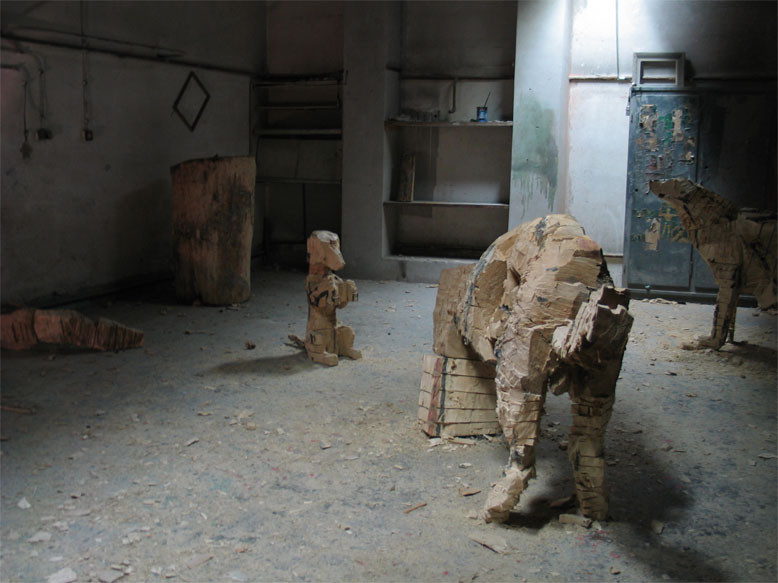
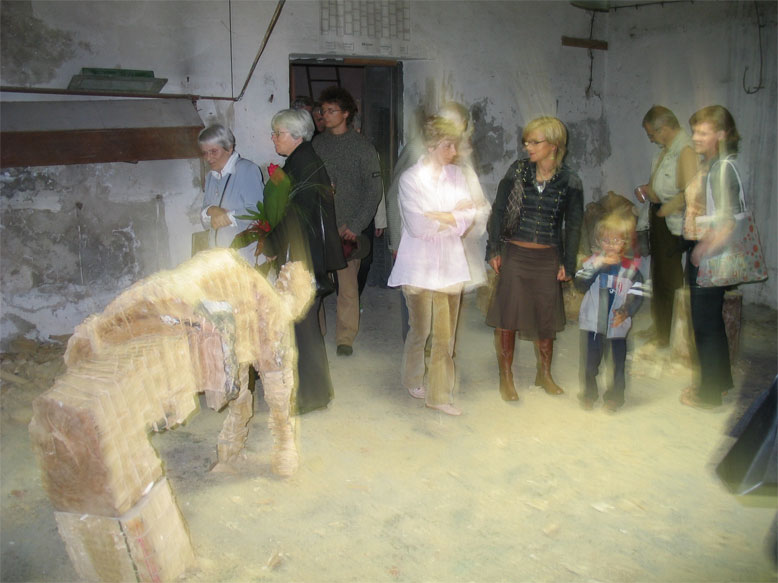
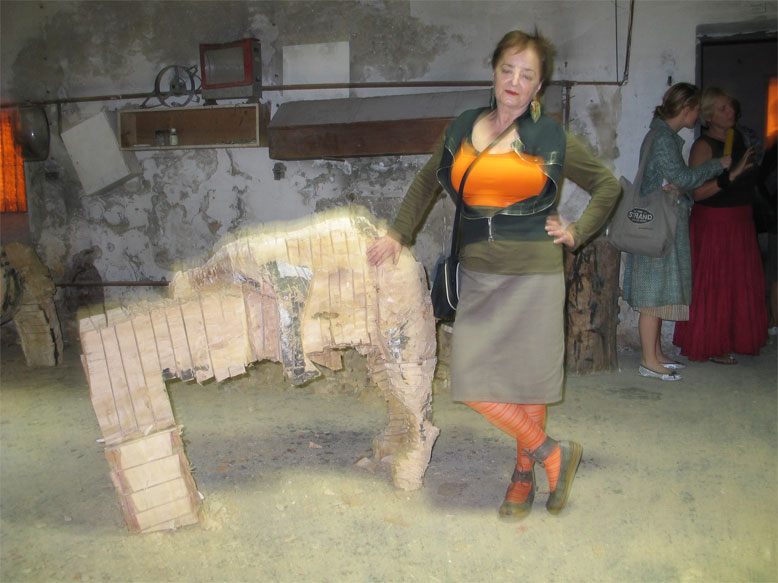
Wojciech Pustoła likes tension. He is an avid listener of Shostakovich - and not of the pretty fugues of the composer's last period. No. He likes when the guts are spilling over, when the pain isn't even sublimated, when it's there, bare. He sculpts dogs. Various positions, sizes. There is a nervousness in the form, an irritating intensity, like when someone keeps the flashlight pointing to your eyes.
Wojciech Pustoła prepares his final presentation - the one that will correspond to an academic thesis. The dogs are ready.
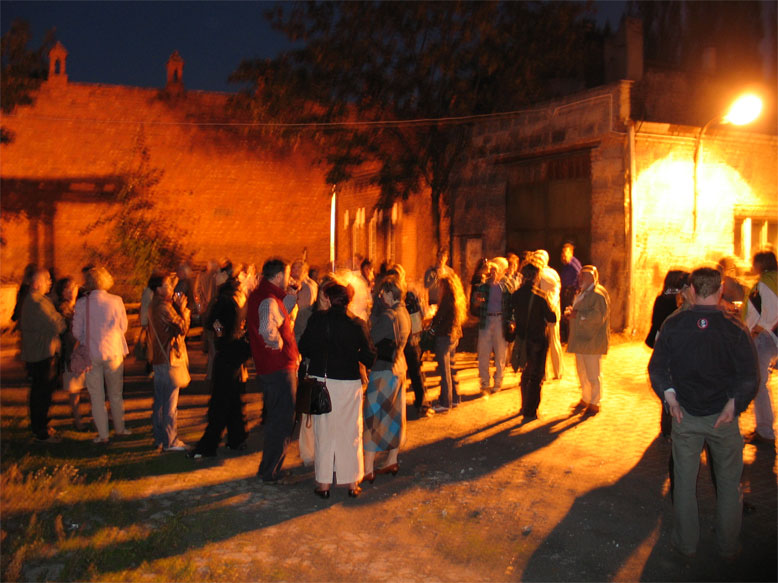
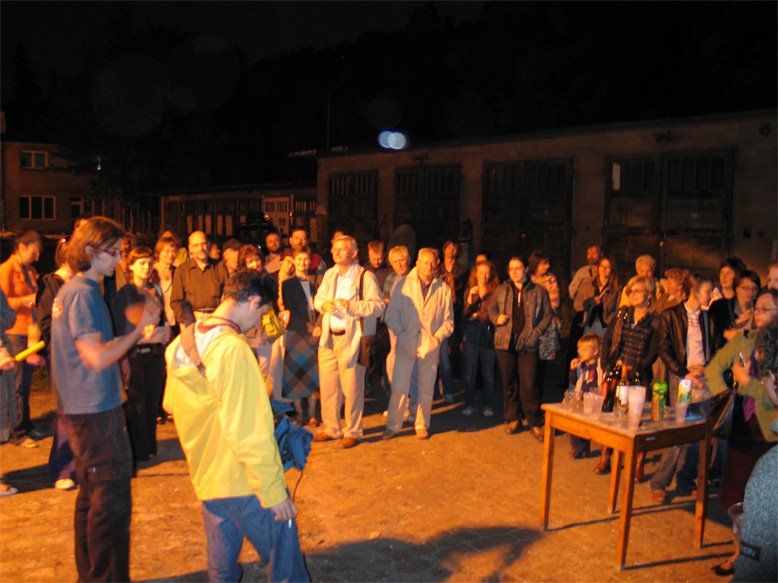
But he doesn't wait till the day of presentation. Instead, he organizes a vernissage a few days earlier. He invites the broadest range of people possible: art curators, family, security guards, businessmen, construction workers from a site nearby, distant relatives...

There is, of course, an opening ceremony...
...during which the artist speaks about everything one expects him to - and more...
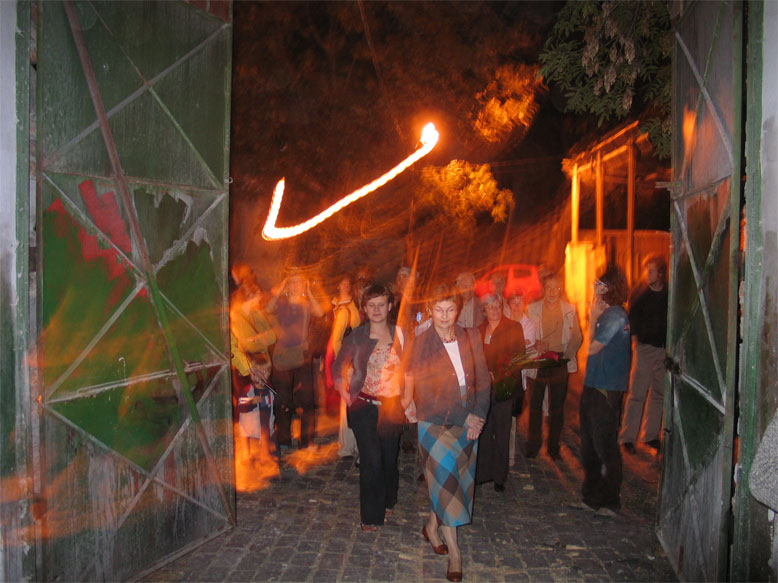
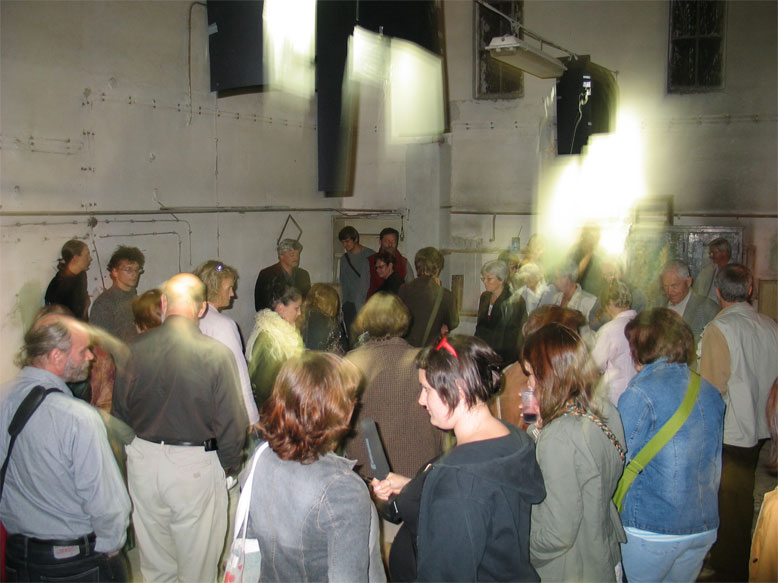
...then everyone procedes to see the sculptures

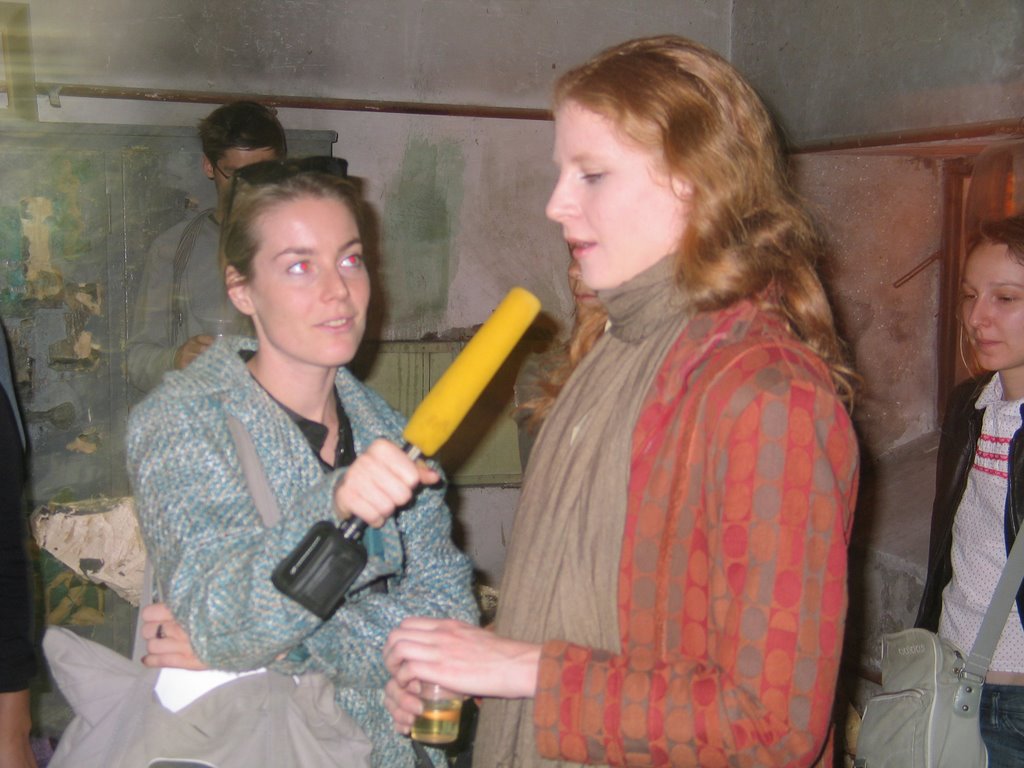
While the spectators are discovering the works, a few people with microphones circulate, asking questions.

Some of the questions are: Can you descroibe the best work here to someone who isn't seeing it? Why is it so dark in here? What texture do you like objects to have? Why? Do you ever feel like touching objects? Do you think it depends on you or on the objects? Doesn't this pink wall irritate you? Why dogs? Is there any work you don't like particularly? Can you describe it to someone who isn't here?The jury is also invited. I haven't received any information on whether the jury was present or not. But this is not the presentation. The presentation, as I mentioned, comes a few days later. The jury arrives. You guessed it: the room is empty. Not a sculpture in sight. There are a few speakers spread through the space. Each of them has fragments of the recorded interviews. And that is all the jury gets.
Here is what happened:
"it all went great, very human, people started talking and having conversations, the jury was completely blown away, all these simple folks discussing about the meaning of art, like children"
Like children. This is what I like about it. What could have become a somewhat annoying conceptual work about absence became a reminder of the experience of art. Of our contact with it, and how much an unfinished dog with square legs can mean to us. Even once its gone.Monday, October 02, 2006
2 single events by Fernando Ortega
Fernando Ortega introduces himself by letting go a cry. During a Sonic Youth concert. And whoever looks at him - or doesn't - is unknowingly performing the choreography for an introduction.
One beautiful thing about this work is that it's seemingly uneffective. The limit of Ortega's cry is all too clear. Nobody is paying attention. Except this guy there in the middle. And the one to his left. And those two on the far right. And the one above them - is he looking here?
This is the common space. The space of the exchange of looks. The anonymous, planned but improvised meeting takes place between these few people, as they are looking in the direction of the screamer, the artist.
I like this work. Recently, I discovered that this blog feels similar. It feels like screaming your guts out during a Sonic Youth concert, and if you're not paying attention, it seems like nobody really cares. But as you look closer, there are some individuals who actual do give a damn, a few of them I meet personally, some of them I bump into by coincidence, others I discover on the net. Not that many, if you eliminate all the completely accidental visits, and the people interested in cutting the penis. But more and more.
Going back to Fernando Ortega, one qualityhis work has is that a lot of it consistently develops one theme: the impact of the single occurance, maybe an anonymous one, or apparently not even an event. Something happens, somewhere. The beauty of the artist's role is then to put this forward. To make us realize the potential importance of that event. Paraphrasing the Polish poet Wisława Szymborska, we discover that the unimportant can be of more importance than the important.
More of Ortega at the Lisson Gallery site.
Thursday, September 28, 2006
The naked teacher: teaching performance art
CNN reports:
Mo Xiaoxin, a 56-year-old assistant professor at a university in Changzhou, in eastern Jiangsu province, shocked students by stripping during a lecture on "body art" to emphasize the "power" of the body and to "challenge taboos," the Beijing News said.
"There are no taboos in the field of research, but to do this directly in the course of teaching is obviously not appropriate," the paper quoted Tian Junting, a culture ministry official, as saying.
The lecture was part of a course within a newly established "human body art and culture" research institute -- China's first -- at Jiangsu Teachers University of Technology, the paper said.
Mo arranged for four other models, including a man and woman in their 70s or 80s, and a younger couple, to strip naked in front of the class while he lectured, the paper said.
Scandal? Or trivial event? Are we to see this through the eyes of an art critic for whom a naked body is just another element of artistic expression? Or should we rather interpret it from the students' point of view? Would it then be an indecent act, a very embarrassing one? Of course, the article says little about the context of the class. It was part of an experimental course on body art. But was it a practical course? Is a practical course in body art actually possible? I've heard of body art workshops where people were encouraged to self-mutilate. How exactly does that work? Does one train various techniques, until one gets them right? Is there a set of "exercises" one has to execute to pass?
If we accept that a significant part of contemporary art looks to go "out of the box", teaching it becomes a challenge. Trust me, I know. The whole idea is how to get someone to accept the excentric as central, i.e., how to see ("alternative") contemporary art as a basis, or a context for work. This is extremely difficult, much more difficult than just learning to appreciate it. On one hand, the students need to comprehend the strength of new works, the impact they potentially have; on the other, it's not enough to see it in a distance, in an attitude of all-encompassing tolerance. This - body art, performance, controversial or plain shocking installations - is to be, if not a foundation, at least a contemporary history. That means, it needs to be close enough to be useful, to be felt as something we might have done, but (often fortunately) don't need to do any more.
Does this mean the teacher was right? Only if he achieved his goal. Only if the people watching him not only got the point (their point, not necessarily his point), but also, will feel empowered through the experience.
But teaching it? Or: actually doing body art (if getting naked comes anywhere near as much as an introduction to body art) in front of the students? Two points irritate me here:
1) A teacher that instead of making the students discover things by doing them does them himself is at least suspicious. I'd rather have a scandal where the teacher convinced students to actually do body art. At least then, they are the performers, and not just forced spectators. The article states that the teacher tried making the students undress too. It seems it didn't work. Was there any room left on the stage?
2) On a more personal level, art that aims to "break taboos" rarely ever speaks to me. It's not too hard to watch. It's too easy. As one ex-body artist said, the performers are not the only ones sweating. The audience sweats too - of a specific embarrassment and more often than not, a deep desire to be somewhere else.
My doubts regarding Mo Xiaoxin are both as a teacher and a perfomer. But they have little to do with indecence.
Wednesday, September 27, 2006
Thinking digital differently
As any truly experimental project, it has its more and less successful bits - some works seem a little unfinished, as if not nurtured. Also, the navigation is absolutely complicated - but that makes it easier to wander aimlessly, appreciate whatever comes up, and not get the false impression that you're in control. The general feeling is of a rich, dense garden, whose sense still evades me. (Though not the senses).
hint for the desperate explorers: once at pixelnouveau, scroll to the right.
Size matters?
Size matters? How exactly?
----
Kant's distinction between aesthetic experience and sublime experience could mean that, for instance, when visiting a pyramid I am so overwhelmed by it, the experience ceases to be aesthetic and becomes sublime. If we hold on to this distinction, we could risk saying that the experience of art may be similar if it belongs to the same category: in this example, the Louvre pyramid can have a strong aesthetic effect, but it lacks the size that could overwhelm. Does our sensibility really work the way the kantian categories would like it to? I'm not sure. Today, size, even when we're talking about really large-scale sculptures, seems just another element of our overall artistic judgement (notice how we're backing up from the idea of aesthetic experience, though...).
---
Take a few works: Jeff Koons' Puppy, Douglas Gordon's 24-Hour-Psycho, and Chris Bors's answer to it, 24-Second-Psycho. Or even the Colossus of Rhodes a few years before.
Why, then, does playing with size/scale often feel like cheating? Is Kant the answer? Do we basically enter other categories here and become overwhelmed? If so, shouldn't the issue of the scale be ignored?
---
Then again, scale is balance. Looking for balance is also looking for the right size. The right ontology, the right way of being, as if we were looking for some sort of homeostasis, balance or harmony, a balance which has as much to do with the object itself as with the context. But is Michelangelo's David any worse for standing in the Accademia Gallery?
---
When Cattelan makes a praying Hitler, the strike of genius is making him small, like an innocent being. Because size plays a role. That means size has a character, smaller is cuter, larger is more impressive, etc.
---
But then how do we cope with pictures of things? Why would our imagination compensate so well in a model representation, but have so much difficulty in regards to the original?
---
Going back to Kant, we could say that playing with the size factor is an expression of frustration with other qualities. Take Oldenburg, for example. Here is a fragment of a beautiful text he wrote in 1961:
I am for an art that (...) does something other than sit on its ass in a museum.So, in the case of Oldenburg, where is all this art gone? What is it that makes one move from the majestic art of dog-turds to huge post-ready-mades? Could size-ism be a form of escapism?
I am for an art that grows up not knowing it is art at all, an art given the chance of having a staring point of zero.
I am for an art that embroils itself with the everyday crap & still comes out on top.
I am for an art that imitates the human, that is comic, if necessary, or violent, or whatever is necessary.
I am for an art that takes its form from the lines of life itself, that twists and extends and accumulates and spits and drips, and is heavy and coarse and blunt and sweet and stupid as life itself.
(...) I am for the art that a kid licks, after peeling away the wrapper.
I am for an art that joggles like everyones knees, when the bus traverses an excavation.
I am for art that is smoked, like a cigarette, smells, like a pair of shoes.
I am for art that flaps like a flag or helps blow noses, like a handkerchief.
I am for art that is put on and taken off, like pants, which develops holes, like socks, which is eaten, like a piece of pie, or abandoned with great contempt, like a piece of shit.
I am for art covered with bandages, I am for art that limps and rolls and runs and jumps. (...)
I am for the art of underwear and the art of taxicabs. I am for the art of ice-cream cones dropped on concrete. I am for the majestic art of dog-turds, rising like cathedrals.
---
For the lover of big-scale things: how to create large projections on buildings.
For the lover of small-scale things: very small objects. And also, a site full of small bits and pieces of small-scale video art by Alex Pearl, a reader of this blog.
Thursday, September 21, 2006
Banksy exhibition...gallery-style

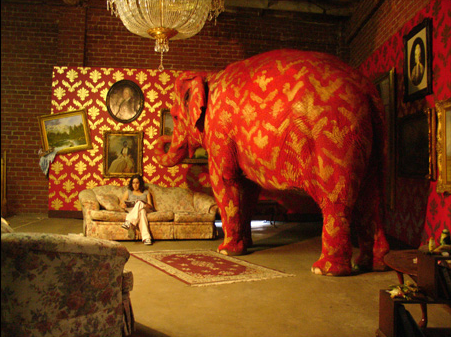
See this great text by Valerie Palmer about a recent Banksy exhibition. The elephant was apparently a fitting centerpiece and stole the show from the political ideas we're used to seeing from the British sweet-painting rebel. Bottom line:
The power of his work lies in the way it interacts with its environment and that obviously gets lost when you put it in any kind of gallery setting.I guess my wish came true.
Question: Is there any way for revolution to go mainstream?
My answer: No.
Question: What about Cattelan?
My answer: Come on, that's softball compared to Banksy. Cattelan's subversion is a Viennese Waltz compared to Banksy's creative punk attitude.
Question: So how can a guy like Banksy gain recognition?
My answer: He's got it already.
Question: More recognition?
My answer: What's the point? To "promote his values"? Let's face it: the value of critique is that it criticizes. Once it becomes part of the game, it smells of hypocrisy.
Question: What about subversion? Isn't that an option?
My answer: Possibly.
My answer after having though about it for a minute: But there's something cynical about it, isn't there? While in the case of Banksy, there hasn't been so far.
Question: Well, how is he supposed to make a decent living?
My answer: I don't know - find a sponsor? Hell, if I knew, I would be doing it already.
My alternative answer: Just as the jester's role used to be an intelligent critique, also of the ruler, and he made a living off it, so there might be room for an official jester... In the best of possible worlds, that is.
Tuesday, September 19, 2006
Style. Beyond the individual

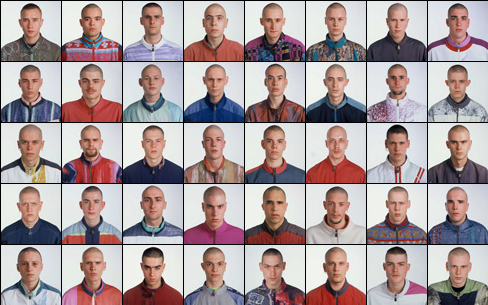
Exactitudes (= exact attitudes), by photographer Ari Versluis and stylist Ellie Uyttenbroek, is an exercise in style (or rather was, from 1994 to 2002 - it is now present online, in a traveling exhibition and in the form of a book). Style is what makes the person unique, but also, quite paradoxically, what makes her so easily categorized. Some say the search for identity isn't at all a search for authenticity (which is a controversial concept), but rather, a search for style. Identity, here, would mean a sort of a definition that allows one to make a drawing. So here we have it, those young boys are making the drawing of themselves - they are getting themselves defined, they are become unique, and totally anonymous at the same time.
It is quite an exciting balance/game/tension, between the self-as-unique and the self-as-participating. Exactitudes shows it clearly. Maybe a little too clearly. It might be because the work is somehow dated, and that, beyond the fact that styles have evolved quite a bit (another proof that identity might be more about style than we think). The pictures, their esthetic qualities, but also the way it was made: the styling, the forcing into categories. Is it necessary? The argument, found in the "about" part of the page, that everything is stylized anyway, simply doesn't seem enough. That's why the groups that speak most to me are ones where the difference, and the similitude, are there, impossible to hide, like in the Tattoo Babes series, or the Dreads one. The others often seem forced, as if the similarity sometimes wasn't enough and needed to be underscored - and it really needn't! Maybe in these two cases, the presence of the naked body seems like something more honest, less manipulated? Then again, come and think of it, the tattoos could be fake.
Saturday, September 16, 2006
Al Magnus: taking children seriously
How surprizing is that? Of course, these are images of fairly tales. Some actually ring a bell. Most are rather fairy tales in themselves. But to start off, remember they were not meant for us, but for the little ones. Hopefully, that can be a good enough excuse to enjoy, as we usually enjoy the things that weren't meant for us.
Then, of course, there is more. The above image, called Paisagiste II (Landscape Designer II) has two versions. The first one is in color. This one, however, is quite different. By taking away the color, the general atmosphere becomes heavier. But there is another change. The boy pulling on the rope all but disappears. (Yes, there is a boy pulling on the rope). Suddenly, we discover the designer is not quite the one we thought it were. Maybe, because in the tales we know, we can only think of one designer.
But isn't the designer someone with the power to reinvent? To construct, but also, to make a Very Silly Thing (La Grosse Betise)?Maybe, the power of attraction of children's tales is not that they're far-fetched, incredible, fantastic, but that they design things in such a way that we feel this world-changing design on every step? This is a big difference, since we rarely associate children's stories with the creation of order. Come to think of it, it is an order that they have in common with some, maybe not all, art. And so, the trivial idea that artists are the adults that remained (or went back to being) children can be understood in a whole different way. Artists treat designing seriously.

Wednesday, September 13, 2006
For V.
Remixing stuffed birds
Pour les dents d'un blanc éclatant e saines (meaning: for teeth that are shining white and healthy) is an installation by Jeroen Diepenmaat. In it, stuffed birds play records by putting their bill into the groove. One of the impressive things about it is that it's not one of those suggestive works that actually only work as a symbol. It works! On his site you can listen to the sound this and other installations make, or you can choose to chill out to some collaborative re-mixing he's been making. All his works seem to be evolving around vinyl and old cars, and often include interesting ways of callaborating with others (artist, students, groups of unsuspecting passers-by...). Speaking of vinyl, it's impressive how old-style vinyl lovers keep reinventing themselves. Is there anything better for creativity than apparently disqalifying limits? Could this be a difference between the amateur and the professional? The amateur doesn't need limits to his areas of investigation...
(via)
Tuesday, September 12, 2006
In these dark days
More here.
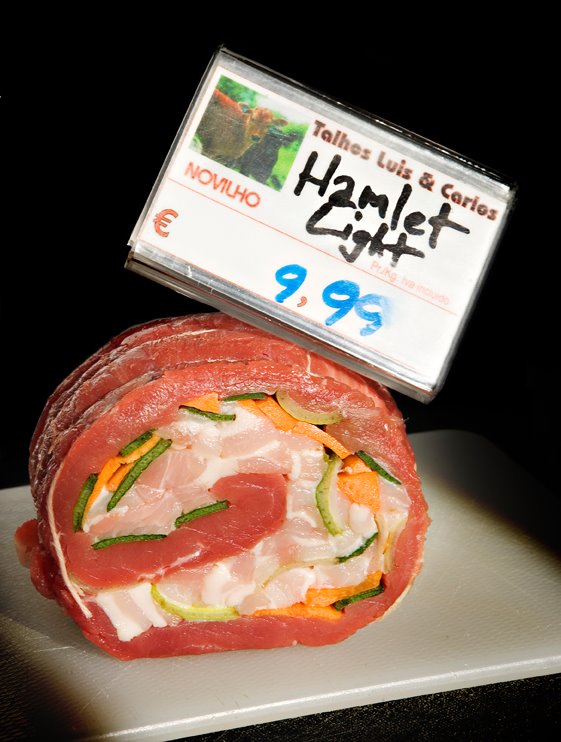
He's for a jig or a tale of bawdry, or else he sleeps. - Hamlet
(via)
Sunday, September 10, 2006
September 11
***
I found the second of these two works by Peter Coffin as an illustration to this article by art critic Jerry Saltz. Two other discoveries Saltz provides are the Strange Powers exhibition at the Creative Time gallery (unfortunately judging from the participating artists, and not a visit...) and a quote by Erik Fishl:
Imagine calling two pets, one a dog, the other a cat. Asking a dog to do something is an amazing experience. You say, "Come here, Fido," and Fido looks up, pads over, puts his head in your lap, and wags his tail. You've had a direct communication with another species; you and Fido are sharing a common, fairly literal language. Now imagine saying, "Come here, Snowflake" to the cat. Snowflake might glance over, walk to a nearby table, rub it, lie down, and look at you. There's nothing direct about this. Yet something gigantic and very much like art has happened.
A few questions: If the dog stands for entertainment (as I believe it could), doesn't it value entertainment? I mean, in this example, why would the cat always be the better of the two? Don't you ever get the feeling the cat simply doesn't get it? And what about cat cynicism? Where does that leave art amateurs, huh?
Found thanks to the nonist
Saturday, September 09, 2006
Friday, September 08, 2006
Próżna 2006 (translation of review by Dorota Jarecka)
I rarely do it, but it's worth it. The following is my translation of an article by Dorota Jarecka that appeared yesterday in the Polish newspaper Gazeta Wyborcza.
The Project Próżna 2006 breaks with the sentimental-folk climate of the "Singer's Warsaw" festival. Nobody here tries to prove that one can return to the past, bring it back to life or play it back.The Ulica Próżna 2006 Project
curator: Krystyna Piotrowska
until September 10, Warsaw
Every year the "Singer's Warsaw" festival attracts people to the otherwise deserted Próżna street and creates a fiction. The forgotten climate of a forgotten Warsaw appears again. The artistic project in the building at Próżna 7/9 is a whole other story: no orchestra rhythms, no singing cantors, no Jewish cuisine or cut-outs. Here nobody tries to make anyone believe that the one can go back to the past.
It's a rather painful than happy contact with the past, and the pleasant feeling of participating in a fiction is questioned and treated mistrustfully. The building was designed in the 1880's by the architect Brauman for Naftal Perlman. It was later bought by Zelman Nożyk, founder of the synagogue on Twarda street, the only one in Warsaw to survive the war [WW2]. The building extends along Próżna street, it has several entrances and reaches as far as the Grzybowski square. In 1940 it was inside of the first large ghetto. In the summer of 1942 the ghetto border was diminished and the building was left on the outside. That's why it wasn't brought down after the collapse of the 1943 [Jewish ghetto] insurrection. After the war it had state-owned apartments. Nine years ago it was bought by the Lauder Foundation, who sold it two years ago to a developer called Warimpex.
The house, together with a few neighboring ones on Próżna street, are something unique in Warsaw, since it survived both the Warsaw Insurrection [in 1944] and the reconstruction of Warsaw, but they also didn't undergo nearly any remodeling or improvement. They look just about the same as they did in 1945. When the Lauder Foundation bought the house, the locators renting apartments had to move out. There is always someone there in the abandoned houses, ripping out the old tiles or stealing the balustrade. The water pours in through the roof. We can check by ourselves: in the last years the house at Próżna 7/9 turned into a ruin. It would require an archaeologist to distinguish between war damages and the devastation of the last few years. All the signs mixed together. The house is a conglomarate of damage.
That is the house that artists have entered. Since the very first meeting with art here, we are nearly swept off our feet. Katarzyna Krakowiak, a young sculptor (teacher at the Academy of Fine Art in Poznań), filled the floor of one of the entrances with sidewalk tiles. They give to the first step, caving in. We discover they are laid on an air-filled, rubber foundation. We walk as through concrete waves, on a shaking ground. The work is called "Swindle of Balance".
Another work present was Artur Żmijewski's "Our Songbook". It consists of a film made in Israel - emigrants from Poland, 60 to 80 years old, sing Polish songs. It is an astonishing document. It shows there are no easy national qualifications. Żmijewski says: there are limit identities, fluid ones, impossible to name by a political or media language - and even less by the language of official passports. In his film, the artist shows the counsciousness of a specific group of people living in Israel, but one which is neither the consciousness of all Jews, or of all Poles.
The "Ulica Próżna 2006" project is exactly such a collection of individual messages. Krystiana Robb-Narbutt created a narration about her family which didn't survive the ghetto. It is made of toys inside of glass aquariums. The history is told with a naive language, seemingly inadequate to the events. Yet the subject is the very search for a language. The props used in this story (the toy wagon stands for the transport, the Christmas decoration "angel hair"[bands of very thin stripes of translucid plastic] is the grey hair of an old woman) are a conscious choice of an immature language. Because any other language lost its value and can no longer tell the story.
The common language becomes ridiculed. Something is "Jewish", something is "Polish" - but what does that mean, exactly? In Krystyna Piotrowska's installation, a real, live carp swims in the bathtub. Next to it, the artist put two recipes for carp taken from an internet cuisine book - carp "Polish style" and carp "Jewish style". The Polish one is a little more caloric, but it's pretty much the same. And the carp doesn't know what nation it belongs to.
A wooden model of Próżna street, as it is to look after the remodeling (to be made in near future), stands in one of the rooms. The developer wants to create a luxurious hotel in this building. The empty, enormous apartment on the second floor where I managed to enter, with the traces of the old life, with the colors of the old paints still on the walls, will be gone.
Próżna street cleaned of its junk and cleanly painted is a problem for me. In Poland what tells something about history is not reconstructed antiquities, but crumbs, wrecks, litter. The flashy, crystal clean street will stop being Próżna [meaning "Void" or "Vain"] and become Empty street. Yesterday, walking through the house at Próżna 7/9, I had the feeling that I'm walking through the real museum of the history of Polish Jews. How can we save it?
- Dorota Jarecka
Extra: from the curator's note:
The way Próżna street looks makes it completely visually autonomous from its surroundings, the current center of Warsaw. It puts it in an aesthetically and historically provocative oposition to the contemporary city. It constitutes a dramatic shock of a dead and decaying fragment of the city of the past with the live and indifferent city of today. It is the image of a conflict that is both ethical and aesthetic. It is the fruit of a German crime from times of War and of the post-war indifference.
Such a dramatic tension in the city space is an inspiration for the creation of the Artistic Project "Ulica Próżna 2006". The goal of the project is to show how the newest language of art can relate to this past and this present, which the opposition of Próżna street with its surroundings calls upon. (...)
The Artistic Project "Ulica Próżna 2006" is also open to interpreting it from the perspective of such contemporary phenomena as cultural, religious or political foreignness and animosity. Also today, they lead towards crime on a mass scale. - Krystyna Piotrowska (Polish fragment here)