Wednesday, October 01, 2008

Where is MySpace? Filippo Minelli's "Contraddictions"


Filippo Minelli, Contraddictions series (ongoing)
The ones I really like are the ones playing with the double meaning: DOUBLE LIFE, MYSPACE. But if they were left by themselves, I supposed I would have found them annoying. Too simple, too propagandesque.
Here, however, the artist creates a context, creating a whole network of worlds we know very well - from somewhere else.
And among those, the ones I really appreciate are the virtual worlds. YouTube written on an old wall in Phnom-Penh is great, because one of the things it says is: this is not virtual. This is here, it is a real place... And of course, as it is doing it, the contrast appears.
I only wish there were less photos, less brands. Otherwise, the entire set might seem a bit too vast, fleeing into the vagueness of the global companies.


(via)

Tuesday, September 23, 2008

Finishing off the Flesh Series


Found at Rebel:art among other (excellent) participants of the International Sticker Awards (to be announced on October 3) is this wonderful example of product sabotage, by Thomas Judisch. The sticker simply says "free sample". You can agree with the ideaology or not, but you have to admit it's ingenious to say the least.
This can also be a vengeance of the vegetarians after all the flesh-fuss that has been appearing on New Art.

Sunday, September 21, 2008

Body of Flesh: Pinar Yolacan's portraits


Age is violence. It is violence as in: power, and it is violence as the inevitable overpowering.
The women on the pictures from the Perishables series (2004) by Pinar Yolacan wear this age in a way that brings about strong feelings. Disgust? Humiliation? But why? Why is wearing meat so shocking? We do get it - the meat is just a continuation of what we are, it is as sacred or as profane as we wish to see it. So why does it seem so intensly profane? Why is it revolting?
The women on the pictures don't seem embarrassed. To the contrary - they know who they are. And they know how deep is skin-deep. And possibly because of their incredibly stoic stance, we reach another point - of acceptance, of peace.

There is a wisdom in these wrinkles that seems unbearably right. And beyond the purity of light, may I add - there is also pain.

The exceptional thing is - this pain is distinguished. And if you think it's because the subjects were WASPs, see Pinar Yolacan's the Maria series (2007).


Here are women from the Bahia region in Brasil, which was colonized by the Portuguese. And here, the flesh changes its value: it is not about age any more, but rather, about distinction and pride, but also submission and humiliation, about the color of skin and the heaviness of the-object-that-thinks. Maria is the most common Portuguese name - and in Brasil nearly every woman has Maria as one of her names. It is also a reference to the Virgin Mary, a reference that here challenges our thinking about holiness. Look at this raw, dark flesh, and see the purity.

It seems to me Yolacan does not really have a statement that guides her work (interview with the artist here). Vanitas. Possibly. But I'd rather see her as a researcher - she investigates what the matter - the flesh - can tell her, where it can lead her. And this very intuitive, "non-rational" way of working is something I cherish. Because if you listen carefuly, your own sensitivity will embrace the matter in such a way that, once it is done, the work might speak the thousand words you never knew you had.

Friday, September 19, 2008

On blogging, the power of images and misbehaving


Here we are, now, entertain us.
In a comment to my last post, Matka wrote: Please, add a new piece soon! My internet explorer opens with your page and this work makes me seek [sick?] for a couple of hours.

Independent on whether this particular request should be executed or not, a serious issue creeps up behind: can we speak of a more or less bloggable material? Should we?
At first, there seems to be no doubt: a blog is personal by definition, right? The author decides what to put on it, and that's it?
Not quite.
1) Any reader of art blogs will notice blogs have formulas and tend to stick to them (this is not just the case of art blogs, obviously). So there is a topic, an approach, a way of writing and really, a "strategy". This can be a personal strategy, but it remains one.
2) In the case of art blogs, strong images work. That is, if you're looking for an audience, don't spend so much time writing: find attractive images. They can be shocking, but they have to be instantly rewarding for the spectator. And that's disgusting, dear Matka.
There's the rub: A blog is like a light version of a magazine. You drop by, take a glance, and in case of picture-filled blogs, if the image is not appealing, you move along. I see it in the stats, I know it (mea culpa) from autopsy. An art blog is, to a great extent, a mini-gallery. To a neophyte observer it might seem like people only take a glance and then leave. But after all, isn't it about those few that stay a while and dwelve deeper?

It's nice to be visited. And appreciated. And the more popular you are, the more, humm, popular you are.
The point is, it influences the choices you make. And all of a sudden, you know what sort of images work on the blog. And those are the ones you choose. Fast art consumption. It's nice, it's clean, we get it. Good, effective art.
Then the next step might be thinking about not offending Matka's tastes. And that's scary if you write a blog, (a personal page). But then, even if you don't go that far, the blog, the site, gains a life of its own. And thenyou start listening in on what it wants.

Come to think of it, it's not necessarily horrible. After all, it's also the wonderful feeling of an object coming to life, gaining an identity. Indeed, in the case of this blog this life has been continuing even during my absences. And that's a beautiful sight.
Yet it is still mine. Heheh...
And hopefuly, the lapse in Matka's text did make sense: beyond making her sick, the image also makes her seek for a couple of hours.
And in case it doesn't, here are a couple of replacement images. If anyone here can handle Japanese, please go here or here and let me know who is the artist, and what is going on, these sites seem creepy as hell...

O, that this too too solid flesh would melt
Thaw and resolve itself into a dew!

Oh, that this too, too solid flesh should melt


Not fit. (As if fit actually still meant fit for something). Too much body in the body. Too much flesh in the flesh. Too little shape. Too little containment. The form is amorphic. It isn't even interesting in its lack of shape.
Someone once told me he kept surprizing himself by how profoundly average he was.
What argument against it? Self-awareness? That's pitiful. I say, tie him up with a thin red line. Make him dance like a ham. Make him squeek, make him laugh. Now, cut the line.
And see how the marks fade away.
Ever so slowly.

The charming picture is by Alison Brady.


(via)

Tuesday, August 12, 2008

China?


Lace Fence is a product developed by the Dutch designer house Demakersvan. (And when one is not using it as a political statement, it is adorable)

Tuesday, July 29, 2008

Fly Me to the Moon


drawings by Vasco Morao.

Saturday, July 26, 2008

Dream Away. Andrea Galvani

Andrea Galvani, La Morte di Un'Immagine #9 (2006)

Have you ever witnessed something so beautiful it makes you angry? Something that makes you angry because it blows your entire scale, because it makes your delicate struggles for harmony ridiculous, petty, insignificant? This beauty that should elevate you, that should lift you up and carry you through the night, the beauty that is the inspiration and the core, is its exact opposite: smashing, unbearable, hard and cruel. It is a sunset that is just too magical, stars that shine too bright, or an event that seemed like the best of all performances. But what I mean is not perfection, it is beauty. It is not unnerving because it doesn't allow you to access it, like the perfection of the stone. It is unnerving because it takes away your ability to judge it, or what's worse, it's a type of beauty that takes away your ability to include it into your appreciation of beauty. It makes it silly to think of art, to create, to go to galleries and museums, to scan art blogs and dwelve into poetry. It leaves you lonely, ridiculously hanging on to an outdated scale or desperately trying to adapt it to something that corresponds more to what Kant calls the sublime - although the problem is, it is not sublime, it is exactly what beauty could have been, had you not already developed a different scale altogether.
I'm lucky: I forget. The taste fades quite quickly from my mouth, the text evaporates from my head, and so does the view of the sea after the storm. It all starts again for me, and what is left is like a bookmark, a sign that says "this was good" and maybe, maybe manages to reproduce some sort of a sensation of a sensation I had when it happened.
And then, sometimes, if one focuses on this memory, the memory starts growing a new head, one that is nothing like the previous one. One that does not compete in these subjective beauty contests, one that is at once much more raw and more constructed, that uses your imagination but somehow fits it together with whatever surrounds you, adapting the memory into an idea, transforming it into this weird creature that still has the body of a horse, but instead of the head has grown a thick, black cloud. Of balloons.
Delicious.
Thank you Andrea Galvani.

(via)

Tuesday, July 22, 2008

Marek Cecuła. The sense of matter.

I must admit I had no idea Polish design (well, design-related sculpture would be the more correct term I suppose) can be anything like this.
While I'm at it, I must also admit that the moment of becoming a little less ignorant, this moment of moving from a state of nothingness to the sudden illumination by something of this caliber is something delightful.


Last Supper (2003)

Porcelain Carpet (2002)


from the Hygiene series (1995)


from the Hygiene series (1995)


from the Eroticism series (2005)


from the Scatology series (1993)


It does not necessarily make sense. It does not necessarily say something, as in, a thing, as in, a message. It prefers to wink at us, like someone sitting in a waiting room winks at us, right after we finally managed to get our eyes of a gorgeous neighbor. Is that the "I know how you feel" wink? Or is it showing you he knows something both of you know he shouldn't and yet both of you know he certainly does? Is this something you share? A common interest? A common feeling of guilt? A feeling of risk, maybe? This winking, the one I feel when seeing Cecuła's works (not touching them, unfortunately, although that seems a perverse desire), is one of recognition, but also one of daring sensitivity, if not always sensuality. Touching is key? No, come to think of it, the not-touching, here, is what drives the senses right to the matter.
More on Marek Cecuła at his site.

(via)


Sunday, July 20, 2008

The big Fuss: Who Killed Barack Obama?


Once again, Peter Fuss (remember his "For the Laugh of God"?) manages to poke the finger in the right spot.
His most recent work, exhibited at the Out Of Sth exhibition in Wrocław (Poland) (which also has blu's animation on display) plays on our sense of reality.
What I like most about this work is something I didn't notice at first. The first reading, to me, was simple: knowing the fate of the liberal Americans who came to positions of power, it is difficult not to think of the risk Obama is facing. This also might be seen as a cool and lucid way of looking at politics. Can any ideal manage to survive? Isn't Obama, the Obama we know as fighting for "change", somewhat dead, already? Who killed him?
But what I really like about this work is not this seemingly political message. It is the way it portraits us and our own patterns of looking at reality.

The problem is not that Obama may get killed. The problem is our thinking of it as a fact. It is not Fuss's work that is cynical. We are.
Seeing the work on a billboard makes it even more obvious: we take it for granted that things are the way they are, and even if they aren't, too bad for the facts. The billboard is there, so Obama is dead. Who killed him? Guess who.


update/ps: A couple of months ago an Israeli designer created a shirt with a similar text. I think the differences between the two projects prove my point. Having/seeing this on a T-shirt and seeing it on a billboard are two completely different experiences. (Not to mention the completely different level of design). And that's what sets apart a good artpiece from a, well, another one. (Also notice the context - one is set in NY, the other- in Wrocław). Suffice it to say that already a few days after the opening of the exhibition two French tourists entered the gallery (you can see the entrance to the right on the second picture) saying they haven't had the chance to follow the news and they were quite terrified. Now, just to add another level of artsy-fartsy commenting, the person attending them answered they weren't to worry because it was "just an art installation". Ouch, now that's not what I would call effective art guidance. Or what she being ironic?

Wednesday, June 11, 2008

Interlining


...there is enough machine within our eyes
to fill a thousand junkyards full
to make the stone break into plastic clouds
of colored dust
and happy play

...there are enough straight lines that bound a shape
to make us speak right to the point
to get us thinking we are right or wrong
beneath the clouds

See more of Jan Vormann's Dispatchwork here.

Sunday, May 18, 2008

Less art


At times it seems the smaller the intervention, the better.
No, I do not mean to follow a minimalistic path, at least not now.
Minimalism, to me, has a lot to do with purity, that is, starting from a point of nothingness and adding just the right touch.
What I'm thinking is more along the lines of accepting the impurity - starting from a point of overwhelming reality and accepting it. Then, the right touch is really just a point of focus, a frame. Was it Oiticica who walked around with his admirers and made art by simply pointing at objects, thus giving them their artness? Still, even this gesture seems like too aggressive, too intrusive. Is it the art-element that makes all tools (all ways of dealing with what appears to us) seem bulky and outdated? Or is it the over-confidence we have when pointing? Isn't this the pleasure of all the YouTubes and darling amateurs? The certainty of some basic form of humbleness?

At times it seems the smaller the intervention, the better.
Yet, I often wonder where does this leave me as an artist. Once I admit a view of some apparently insignificant piece of reality can be a more enriching experience than any work of art, how can I claim anything about my own work, other than the "need" to do it? Doesn't that reveal the horribly narcissistic character of art? But what if I do not want that? If I actually wish to be in harmony with my own tastes? Where does that leave me?
All the above pictures are by Will Simpson at Loshadka, and are part of the You Are Healed series.

(via)

Wednesday, May 14, 2008

Beirut Melancholy


Of course, of course, no art is ever new. Of course, of course, there is more beauty behind us than we will ever see. Of course, nothing can ever compete with harmony. Yet of course, harmony seems never enough.
Of course, there is a time for mourning, and yet of course, the harmony in the mourning chant outcries the cry.

found here

Friday, April 25, 2008

Sticking to it until you get stuck

I suppose the following is a fair comment to this and to that:


More about The Leave Me Alone Box here.

Sunday, March 09, 2008

Hendrik Kerstens: The distant view of the other


Hendrik Kerstens is one of those artists who have managed to develop a career seemingly concentrating on one subject throughout the years. In his case, the model has been his daughter Paula. How different is she as a subject because of being his daughter? Not very. Which is as powerful a revelation as any. After all, one would expect some closeness, some special insight. Nothing of the sort. What we get is a serious young lady, as serious now as she was on the pictures being only a few years old. A gaze that refuses to talk. Our only partner in dialogue seems to be the light that paints the face gently, yet at least on surface, without the love one would expect. We see all the Vermeers and other 17th-century Flemish painters participate in this creation, yet this, here, is darker, less inviting. It doesn't pretend that something can come out of this encounter. Nothing more than a picture, a gaze, a world that is forever there, for us to admire, but not to discover.

Saturday, March 08, 2008

Valentine's

I found this at Happy Famous Artists. It was dated February 14. How come this seems fine on Valentine's Day, but has something offensive about it today?
Maybe it's because VD is for the individual, while today is for the group. And so, today it implies that this is the value I find important in a woman. While on February 14, it is about this one individual being gorgeous. Yet, isn't there something disturbing even about this appearing on Valentine's? The fact that what we celebrate is beauty?
Beauty. Can't live with it, but would have a hard time ignoring it either.

Thursday, January 31, 2008

For (Visual) Art's Sake

Danielle Van Ark's photos often seem unreal, directed. Yet reality seems to provide her with events so rich they seem definitely out of this world. Out of mine, for sure.
See also her great Taxidermy series...


Tuesday, January 29, 2008

EXITO=success / EXIT=exit


I am delighted to inform you that I have been invited by the TR Warszawa theater (Warsaw, Poland) to create and direct a video department/workshop/center/section/thing. There is great enthusiasm concerning the project on both sides.
Thus, I am thrilled to be going back to Poland (at least for some time).
Thus, I am extremely sad to be leaving Portugal (at least for some time).

I hope to have more on this initiative in a few weeks.

For now, all my friends and friends of this blog are invited to a farewell party on February 2, at a place that will be disclosed any moment.

UPDATE>> we will be partying at the Lounge bar (www.barlounge.blogspot.com, although I have no idea how knowing the virtual address can help), at rua da Moeda n.1, in the Cais do Sodre area (by the post office, near the ETIC school). We'll be starting around 11pm. See you there!

Find New Jersey now and win!

Is it possible to take a picture of New Jersey regardless of where you are in the world?

If you think you can answer this question with an image of your creation, accept the challenge of iheartphotograph and participate in the contest.

Two great Josephs


"To be hopeful in an artistic sense it is not necessary to think that the world is good. It is enough to believe that there is no impossibility of it being made so."
- Joseph Conrad

quote taken from the lengthy and uneasy, but interesting Guardian article about Conrad.
(found here)
I should look better and find material that would do justice both to Joseph Beuys and to Joseph Conrad. However, the video above, although somewhat naive, does present Beuys at least in some respect, and has excellent footage from his I Like America and America Likes Me. For more resources go here, and a great overview of Beuys and his influence on today's art can be found on this Tate page.
As for the article about Conrad, its style does actually do justice to the Polish writer. And it is certainly enlightening. However, other suggestions are welcome.


What links those two? What impresses me? Beyond a difficult, though creative, dealing with one's identity - which that doesn't really make them stand out among artists... A sense of a profound and paradoxically bitter optimism. And amazing self-discipline.


Desert:

The Fat is on the Table
Maurizio Cattelan on Joseph Beuys

beuys is dead
beuys is also uniting love and knowledge
beuys is more present in a desert freak
beuys is sponsored by museum für moderne kunst
beuys is appointed professor of sculpture at the düsseldorf academy of art
beuys extends ulysses by two chapters at the request of james joyce
beuys is surely not a sartre follower, but of course there are many parallels
beuys is mentioned next to steiner
beuys is back in town
beuys is back in belgium, in berlin, US, active in germany
beuys is the contemporary artist responsible for the popular notion that politics is an aesthetic activity that anyone can engage in
beuys is inspired by steiner
beuys is not so reactionary as to deny the existence of the entire art history repertoire
beuys is widely acknowledged as one of the most influential post-war german artists
beuys is the identification with everything from mythological 9gures and historical personages to writers and artists
beuys is a mythical figure in the art world, however
beuys is particularly significant in the light of his introspective research on the possible reuni9cation of human and natural life
beuys is in the creation of the social sculpture
beuys is either loved or hated
beuys is considered one of the most
beuys is widely regarded as one of the most important german artists since world war II
beuys is demanding sun instead of rain/reagan
beuys is more like an evangelist
beuys is famous for an extraordinary body of drawings
beuys is such an obvious candidate; he started making art following a breakdown that was a result of his experiences in world war II
beuys is represented in depth in dia's permanent collection
beuys is
beuys is among the most famous of today's artists
beuys is one of the most famous performance artists
beuys is valid because wolfgang laib shares his belief in the transcendent power of art
beuys is another sculptor that
beuys is one of the major figures in post-war german art
beuys is known for his shamanistic artist's persona
beuys is among the world's most comprehensive
beuys is in these digital photographs represented not by him directly
beuys is a real people's artist understood by a professor
beuys is megjelent a kövek mellett és hamarosan heves vita bontakozott ki közte és a közönség között
beuys is a 1972 lithograph in which the essential feature is that of beuys as everyman
beuys is elvesztette
beuys is átvett és ami interszubjektiv jellege miatt nem volt
beuys is called to account by his presumptive offspring
beuys is veel materiaal verdwenen
beuys is questioned by the activities of maclennan
beuys is instructive
beuys is very important in mail art
beuys is understandable
beuys is known to
beuys is not completed by his death
beuys is i was never secure and happy in the world of galleries from the very beginning
beuys is and how it is pronounced
beuys is cleverly recontextualised in
beuys is of course enormously interesting
beuys is l'eminence grise of community building as an art form
beuys is interested in the proportions between crystal and amorphous states
beuys is able to evoke the experience of the past
beuys is a magnificent
beuys is based on three stages
beuys is a special case because of the build-up of a curious sense of obligation to respond positively
beuys is the generation of my father
beuys is talking about the much wider concept of creative potential
beuys is regarded as one of the most significant personalities of the past
beuys is steeped in the struggle of world war II
beuys is a big influence right now
beuys is unavoidable
beuys is purely a decorative artist
beuys is hype
beuys is cited as the great collaborator of the twentieth century because
beuys believed everybody was a potential artist
beuys is on e-bay
beuys is a mythical figure in
beuys is one artist i wanted to ask you about
beuys is one of the biggest art world phonies of recent years
beuys is probably unique in the history of art
beuys is supposed
beuys is a very controversial sculptor
beuys is grounded in a tradition of narrative sources that is often absent in american art of the same period
beuys is hardly a household name in the history of twentieth-century art
beuys is the great shaman of twentieth-century art
beuys is represented with his monumental work created shortly before his death, lightning with stag in its glare
beuys is best known for declaring "everyone an artist"; koons seems to declare that everyone is a consumer


Sunday, January 27, 2008

Guerrillas looking for Budapest museum director


The site claims:

Position Summary

Museum Director

Director I, Full Time

Monday - Friday, 9:00am - 6:00pm

Hiring Range & Group: 2-4.000 EUR / Month


Closing Date: Open Until Closed

The Ludwig Museum Budapest (LUMÚ) is one of the major Hungarian Museums and exhibition spaces, and holds the most important collection of modern art in Hungary. (...)

Our aim is to create an alternative platform for applicants in order to emphasize the opportunities which lie in this position in order to put LUMÚ on the global map with an internationally recognizable program.


If you wish to apply please send your application (concept) as told below. We do not evaluate but only post all applications on this website.
We hope all decision makers will consider all information collected on this page and will be influenced by your ideas and concepts. We hope they might consider the applicants for the official call. There have been precedents in Hungary where the highest positions have been hijacked by public initiatives in the midst of political status quo. We believe that if you are a sound applicant, you can become the director through public support.

Basically, here is a beautiful case: a group of people really passionate about contemporary art want to have a good museum. So they try to be active. They see that the formal way of solving the issue seems impossible. So they take matters in their own hands, and they announce a pseudo-contest. You can send your candidature, but - and this is the brilliant part - they will not judge it. They will limit themselves to showing those in charge that you exist. And, hopefully, those in charge will take you into consideration when looking for the right person.

Sounds impressive. Guerrillas fighting for justice. Guerrillas who don't want to take over, only think out-of-the-box to try and open minds. After all, if there are competent, interesting candidates out there, why not present them?
A few things worry me slightly: 1) As of today, there is still no candidature online. People don't take it seriously? Possibly. Or maybe, they are not ready to take the risk of becoming associated to something that seems quite a rebellious initiative (after all, it does suggest the Museum has a good chance of receiving the director the politicians will nominate, no questions asked)? 2) What can the real force of such an initiative be? Doesn't it remind you of the rallies that have been so popular these days, say, against the invasion of Iraq? The guerrilla tactics seem more like an interesting phenomenon than an actual force.
Now, the real question might be, what is the strength of this particular utopia?
I hope it does raise the issue of a fair selection. And even if a director is nominated from among the friends and relatives of the Right People, they will have to stand up to the challenge of being compared to the other candidates. The unofficial ones.
What better place to start this sort of initiative than a museum of modern art?
Now, this only works if competent people do send in their proposals. And impress the heck out of everyone.

(via)


Tuesday, January 22, 2008

Species


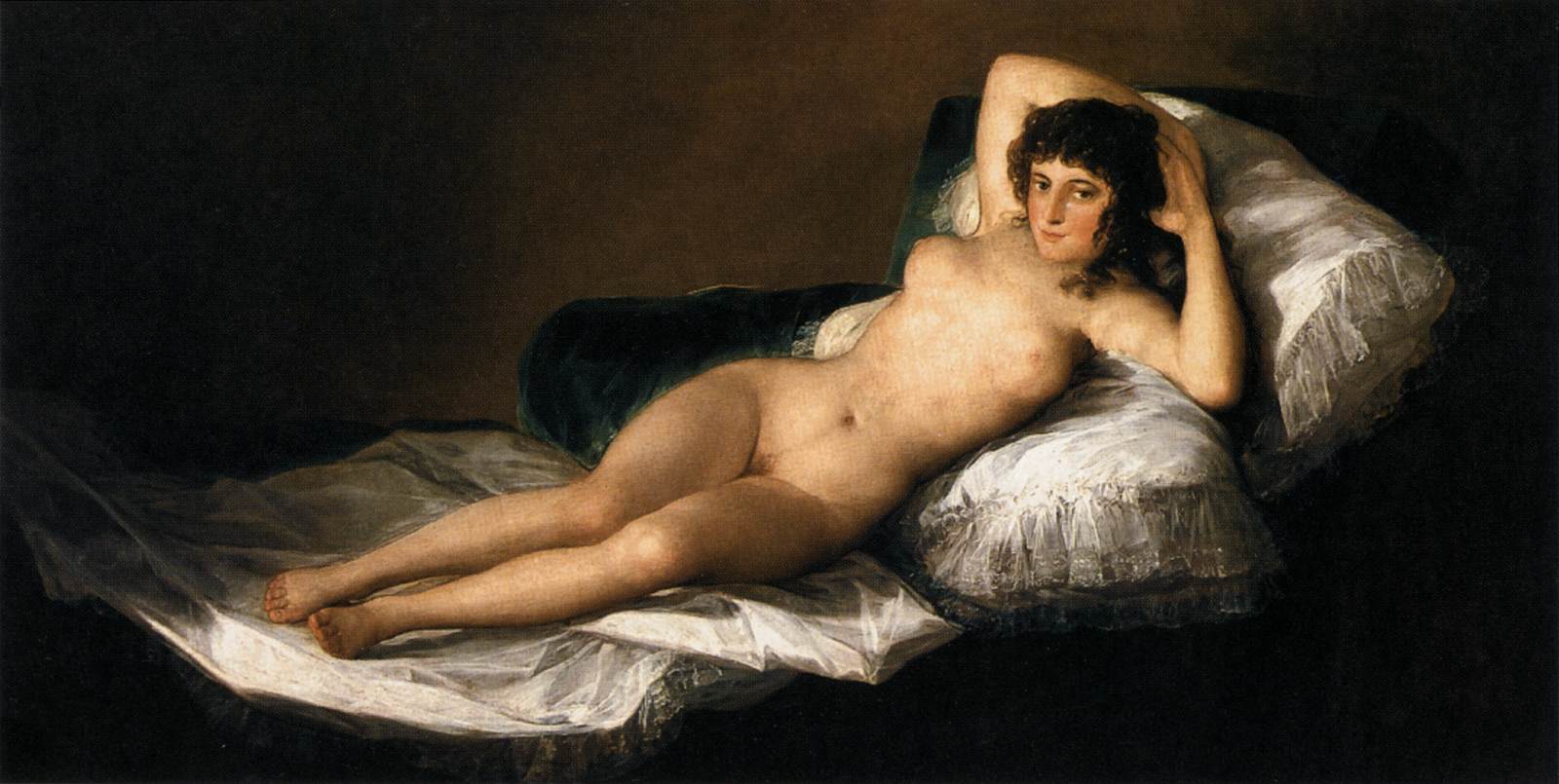
What is absolutely astonishing about this photo by Jill Greenberg is that it seems almost as if taken by chance. Although it is a carefully studied pose, its context is nowhere close to the conceptual play we see here. It is part of a series portraying primates in a relatively classical way - their faces showing somewhat human characteristics, with adequately human titles ("Anxious", "Dude", etc.). They are wonderful and funny pictures, but this one here is really something else. The title is "Mala Centerfold", and that seems an understatement. We are not in front of some cheesy centerfold here. Oh, no! - this is the real thing, this is the indecent Olympia, this is the lascivious Maja.
It is challenging Darwin to a truth-or-dare.
And it is delicious.

Wednesday, January 16, 2008

A few amazing finds, and a very subjective text

Magnus von Plessen, Felicity

It is hard for me to imagine a live performance that would have (that I would find to have) the density of some visual art. Yes, I distinguish those quite clearly, mainly by the dilating of senses I experience when watching most performance, as if there was no way of just getting to the point, or points, or of just hitting me with whatever they have. "Just". There is justice in this just, a sense of the right measure, like an object where the proportions feel right. I simply cannot recall a single performance I have seen where the proportions just felt right. It seems time and a live body introduce elements that are somehow completely out of the scope of my spectator experience.
Compare the best you've seen on stage to this:


The above images, by the astonishing Tim Hawkinson, are more than powerful: they range from publicity-like to classical sculpture to highly conceptual (the last one is a self-portrait mapping of all the area the artist sees on his own body, the picture before is a Balloon Self-Portrait, a blown-up mold of the artist), and yet each of them seems complete.
Or see these, by Huma Bhabha:


How are we to compete with the perfection of something that is? Another language, you will say. Another state of presence. And yet, the choice of what to lay my eyes on remains. And diversity is no argument, when time after time what is live seems to be disappointing, less thrilling, less surprising, exciting, fresh and bold than what remains there not waiting for the sight. But then again, it is also less exciting than film, which seems only to live when seen!
Indeed, it is perfectly useless to speak of the spectator's responsibility in all this, when the spectator admits he is not up to it and instead choses something less desperate, even as it may be darker and, at least on the surface, less active.
(Both poor quality reproductions are by Magnus von Plessen)
And yet, after having written all this, I still feel that live art somehow retains an incredible potential. Not because it is live, at least in the sense of having live people in front of you, but rather, in the sense of it being an event, and so, something that remains unexpected, but also unfinished, incomplete, and fragile in its egomaniacal form ("look at me!"). I'm still not sure where this is heading, it remains confused, but it might have something to do with the amazing phenomenon of enjoying something while it is bad, enjoying it because you appreciate it as an event, enjoying the fact that you are in the privileged position of


PS: Here is a picture dedicated to the effort of some colleagues from a theater project that has been on these days:
(The picture is by Amy Stein. I believe the title is Domesticated.)


Wednesday, January 02, 2008

Duane Michals and Schroedinger's Cat


I really shouldn't. The above work, created by Duane Michals, should be left without a comment.
But how can I resist?
First, let's clear up one issue: anyone trying to better understand the Schroedinger's Cat thought experiment by getting acquainted with this work may be misguided. Although the work plays around with the idea of ontological ambiguity, its way, focus, scope seems to be different from that of the famous scientist. Nonetheless, I am sure Schroedinger himself would refrain from saying such a silly thing as "I wish I had never met that cat", had he gotten acquainted with this little beast (and its charming mistress).

Now, would you look at that. At the delightful play with the point-of-viewness (also, under various other circumstances, called perspectivism or sollipsism or more broadly subjectivism), this attitude of turning the object (of the onlooker) into a subject, and the subject (the spectator, the admirer of the work) into an object (the looked-for, if not the looked-at) is not only a development of motives in art and in philosophy, it is an exquisite retro (the work comes from 1998) portrait of a relation.
This relation is based on faith. Were we to know the cat is in the box, we could not feel the bond the way we do. And yet, this faith does not move mountains. It neither saves the cat, or condemns it. It is rather a sort of a "suspended disbelief" kind of faith, when one ponders, but accepts not to question what is impossible to discover. But this faith also includes accepting not to affirm, as a sort of worldly agnosticism. How are we to deal with what we cannot know or control? It comes to no surprise that Duane Michals cites Zen Buddhism as one of his influences.
Of course, the last picture is a light and funny way of escaping the question (into a new question), but the first two remain. And in them, especially in the first one, there is a hidden level. In Schroedinger's example, the cat is either alive or dead. So when Madame Schroedinger wonders if the cat is or is not in the box, she might not expect the box to be empty. So the question becomes: what is it that makes that presence so present?
The further we get away from the first picture into the next ones, the more delightful the experience becomes. But also the least powerful. From an existential inquiry into you-know-what, it turns into a fun - but not too ambitious - looking-outside-of-the-frame. The work looks at us? Yes, we know. Not a particularly new discovery. And to be honest, it doesn't need to be. Less ambitious? Maybe, and then we can always say, "Who needs ambition when there is such a splendid onlooker peeking out of the box?" I would rather say that since there is no way of knowing the answer to picture number 1, we might just as well accept that and move on. To another possible world - and yet another. Ours.

Question: Have you noticed the box on the first picture might fall if the cat is there and moves as a cat that is there might? Oh, Madame Schroedinger, snap out of it!
Question 2: Have you noticed how much bigger the box is in the 2nd picture? (And how it becomes a non-box in the 3rd...)

More about Michals in this great article.


Found the work here.


LinkWithin

Related Posts with Thumbnails