

Sunday, March 04, 2007


Saturday, March 03, 2007
Wednesday, February 28, 2007
Into the Picture
Among the many fascinating things about yesterday's conference on photography as an art form by Delfim Sardo at the Culturgest, the one that confused me most was the setting.
Since the small auditorium where the conference took place filled up quickly, the organizers decided to allow the remaining spectators (about 50 of them or more!) to sit in the tiny entrance and listen to the conference while watching it on a TV screen.
This is not an uncommon practice. Still, there was something about it that made one wonder. We could hear the speaker, but the image on the TV screen showed only the images that were projected to accompany the lecture (because of the size of the TV, it wouldn't make sense to get the general view of the stage). Delfim Sardo read his lecture, and although I couldn't see it to confirm it and he is an excellent reader, often stopping to tell an anecdote or two, the bulk of it was there in the text. So there we were, all 50 of us, sitting in a hallway, some of us standing or sitting on the ground, to listen to a lecture and see a series of images.
What was it about the event that made it so unique? Was it because we had all traveled that far and didn't want to leave empty-handed? Or was it because it was free? Or because it was so original? One thing was certain: one can hardly say it was because it was live. The conference could very well be an illusionist trick, there could be no one there and what we would have gotten would have been the same: a recorded voice and recorded images. The 'live' aspect of that event was a pure convention. Yet, nearly no one left in the middle.
There is something in the idea of witnessing that is more powerful than the actual thing.
The conference was mainly about the possibilities of using photography as a means of transforming reality, their origins and their impact. We saw the impressive, huge Russian constructivist images and compositions, and the comparable Nazi posters, and the contemporary works of the likes of Jeff Wall - with the references do Velasquez and Monet... All this on a small TV screen reproducing the reproduction that Delfim Sardo made of a reproduction of a reproduction. And yet, it was the real thing.
Now, see the work of Thomas Wrede, photographer. Thomas Wrede seems to be enjoying the idea that it is still, and yet again, the real thing. It can start off with the pleasure of bringing pieces together to create a certain impression of reality:
 This impression of reality takes its power precisely from the fact that it does not correspond exactly to what we feel is real. Only here, reality is an issue of the past. It is something that has been disposed of and now is being reinvented. The question is - what does it mean to re-invent? What is the reference?

 What do we need to know? Which is real? What would be the point? The comfortable feeling of recognition, maybe. But what we get is hardly different.
Let's go a step further, then:
 Don't laugh - this is serious business. What we have here is an image of nature. It is an image of landscape. And that is precisely why what we have here is landscape. Because if we swim in the lake, than it stops being a landscape, doesn't it? Or is what we need the possibility of swimming in the lake? But if we can swim in it, what is left of our contemplation?
 The possibility of touching. Of talking about. Of having witnessed. This is a road. This is snow. This is the light from another place, from another landscape. I recognize this.
(But what is the work here - the picture of the snowy landscape or the picture you see above, with the spectators included?)
Finally, let's move out of this tight exhibition room or hall, let's go out.
 How different is this? It seems just as constructed, just as formally challenging. Just as distanced from what I would think a place is, a landscape is, a view is.
Oh, how I enjoy this hesitation, this pleasure of falling into the trap, into the work, out of the auditorium where the comfortable presence of the speaker would have made everything transparent and much, much too plain.
Since the small auditorium where the conference took place filled up quickly, the organizers decided to allow the remaining spectators (about 50 of them or more!) to sit in the tiny entrance and listen to the conference while watching it on a TV screen.
This is not an uncommon practice. Still, there was something about it that made one wonder. We could hear the speaker, but the image on the TV screen showed only the images that were projected to accompany the lecture (because of the size of the TV, it wouldn't make sense to get the general view of the stage). Delfim Sardo read his lecture, and although I couldn't see it to confirm it and he is an excellent reader, often stopping to tell an anecdote or two, the bulk of it was there in the text. So there we were, all 50 of us, sitting in a hallway, some of us standing or sitting on the ground, to listen to a lecture and see a series of images.
What was it about the event that made it so unique? Was it because we had all traveled that far and didn't want to leave empty-handed? Or was it because it was free? Or because it was so original? One thing was certain: one can hardly say it was because it was live. The conference could very well be an illusionist trick, there could be no one there and what we would have gotten would have been the same: a recorded voice and recorded images. The 'live' aspect of that event was a pure convention. Yet, nearly no one left in the middle.
There is something in the idea of witnessing that is more powerful than the actual thing.
The conference was mainly about the possibilities of using photography as a means of transforming reality, their origins and their impact. We saw the impressive, huge Russian constructivist images and compositions, and the comparable Nazi posters, and the contemporary works of the likes of Jeff Wall - with the references do Velasquez and Monet... All this on a small TV screen reproducing the reproduction that Delfim Sardo made of a reproduction of a reproduction. And yet, it was the real thing.
Now, see the work of Thomas Wrede, photographer. Thomas Wrede seems to be enjoying the idea that it is still, and yet again, the real thing. It can start off with the pleasure of bringing pieces together to create a certain impression of reality:
 This impression of reality takes its power precisely from the fact that it does not correspond exactly to what we feel is real. Only here, reality is an issue of the past. It is something that has been disposed of and now is being reinvented. The question is - what does it mean to re-invent? What is the reference?
 What do we need to know? Which is real? What would be the point? The comfortable feeling of recognition, maybe. But what we get is hardly different.
Let's go a step further, then:
 Don't laugh - this is serious business. What we have here is an image of nature. It is an image of landscape. And that is precisely why what we have here is landscape. Because if we swim in the lake, than it stops being a landscape, doesn't it? Or is what we need the possibility of swimming in the lake? But if we can swim in it, what is left of our contemplation?
 The possibility of touching. Of talking about. Of having witnessed. This is a road. This is snow. This is the light from another place, from another landscape. I recognize this.
(But what is the work here - the picture of the snowy landscape or the picture you see above, with the spectators included?)
Finally, let's move out of this tight exhibition room or hall, let's go out.
 How different is this? It seems just as constructed, just as formally challenging. Just as distanced from what I would think a place is, a landscape is, a view is.
Oh, how I enjoy this hesitation, this pleasure of falling into the trap, into the work, out of the auditorium where the comfortable presence of the speaker would have made everything transparent and much, much too plain.
Technorati:
Sunday, February 25, 2007
Who owns art?
The excellent newsgrist has several articles about appropriation and the issues related authorship.
So who does own art?
 And what is art ownership about? Only in the simplest of all versions is it about owning an object. The thing is, it has been increasingly clear that ownership is one of the most delicate - and taboo - issues of contemporary art. Yes, we have the art market which helps us keep it all together. But the fragility of the system is impressive.
Once you get to Manzoni's Artist's Shit, and keep on going all the way to Cattelan's provocations, something strange happens: not only is the value of the work conventional, but the convention can change quite abruptly. In the case of Manzoni's work, we still have an object. But the further we go into the conceptual & performative realms, the more difficult it is to speak of ownership. After all, how can one own Yves Klein's emptiness?
If art is intellectual property, then what about the image of the work? Is it mimesis? Or a copy of the thing, i.e., a sub-product of the original work? How different is my picture of something from that thing? We often assume it's close - possibly because it's simpler this way. A reproduction is another example of production. But then, what can be reproduced?
If the question is old, new technologies seem to give it a reality bite. We are all photographers. Reproduction is so easy, it seems impossible to judge it by the same strict rules. The tiny video cameras and cell phones make it all-too-easy to take a piece of the world with you.
There's the rub: we somehow feel taking a picture is taking a piece of the world. Reproduction is re-production. Are we therefore constantly stealing the world away? Doesn't that seem a bit naive? Isn't the problem rather in the authorship, and ownership? That is what is happening: by taking the picture of a picture, we are re-apropriating it. Its original value, given by the convention of authorship ('it came out of the head of this person') and ownership ('it belongs to that person'), is questioned. Or maybe rather, challenged, since we can easily imagine someone acknowledging the copyright and taking care of all the related formal issues. (see this article about copyright and contemporary art). There are several issues here. One of them is the question of what exactly constitutes a work of art. If my work includes someone else's work, or copies it, is it a simple legal issue for me to regulate? What if I somehow took the same picture as someone else? Contrary to Joy Garnett, I do believe this can be a serious issue and is not about the public space being public domain. The image, even if it is "just a photo", is still a work. And the difficulty seems to be in acknoledging it every time, that is, even if we just happen to bump into the same view as someone else. Is it a question of recognition? It seems it simply stopped making sense to acknowledge every single picture taken from somewhere else, every picture of a picture of a screenshot of a security camera... But what is the alternative?
What complicates this is that some contemporary art already focuses on challenging the idea of authorship and ownership. That's where the really strange paradoxes appear. That's where one can very well own an 'original' that was made as a questioning of the idea of the original, where the remains of a performance that was a statement for the ephemeral gain the status of permanent art value, etc.etc.
We might be used to this, but there is something incredibly hypocritical about our easy acceptance of it. Why shouldn't we consider that a work of art can actually have a self-eliminating value, that is, have its value limited to an experience that excludes any form of later valuing. This could mean the creation of an exhibition of works not for sale, but it could also mean acknowledging all the works that have been created, often by celebrated and expensive artists, into the void. Such as Gordon Matta-Clark's public, 'illegal' works. They fascinate us today precisely because they seemed destined to disappear, challenging the very idea of an object of value.
Another way of seeing this is attacking (yet again) the very notion of copyright by exposing it to the test of the world. Do we really live our lives in a way that makes room for copyright? Or is it just so out of date that it would need a serious rethinking? See the iMoma, where pictures from the New York MOMA are published. Those are illegally taken pictures, pictures of the visitors, pictures that make the ownership of art-as-image problematic, to say the least. And the officials trying to fight this 'crime wave' seem like ridiculous bureaucrats. But on the other hand - what are they supposed to do? Let it go? And what remains?
Read the story about the iMoma and the image pirates issue at Newsgrist.

Bruce Nauman, Human/Need/Desire (currently at the MOMA)
So who does own art?
 And what is art ownership about? Only in the simplest of all versions is it about owning an object. The thing is, it has been increasingly clear that ownership is one of the most delicate - and taboo - issues of contemporary art. Yes, we have the art market which helps us keep it all together. But the fragility of the system is impressive.
Once you get to Manzoni's Artist's Shit, and keep on going all the way to Cattelan's provocations, something strange happens: not only is the value of the work conventional, but the convention can change quite abruptly. In the case of Manzoni's work, we still have an object. But the further we go into the conceptual & performative realms, the more difficult it is to speak of ownership. After all, how can one own Yves Klein's emptiness?
If art is intellectual property, then what about the image of the work? Is it mimesis? Or a copy of the thing, i.e., a sub-product of the original work? How different is my picture of something from that thing? We often assume it's close - possibly because it's simpler this way. A reproduction is another example of production. But then, what can be reproduced?
If the question is old, new technologies seem to give it a reality bite. We are all photographers.
 Reproduction is so easy, it seems impossible to judge it by the same strict rules. The tiny video cameras and cell phones make it all-too-easy to take a piece of the world with you.
There's the rub: we somehow feel taking a picture is taking a piece of the world. Reproduction is re-production. Are we therefore constantly stealing the world away? Doesn't that seem a bit naive? Isn't the problem rather in the authorship, and ownership? That is what is happening: by taking the picture of a picture, we are re-apropriating it. Its original value, given by the convention of authorship ('it came out of the head of this person') and ownership ('it belongs to that person'), is questioned. Or maybe rather, challenged, since we can easily imagine someone acknowledging the copyright and taking care of all the related formal issues. (see this article about copyright and contemporary art). There are several issues here. One of them is the question of what exactly constitutes a work of art. If my work includes someone else's work, or copies it, is it a simple legal issue for me to regulate? What if I somehow took the same picture as someone else? Contrary to Joy Garnett, I do believe this can be a serious issue and is not about the public space being public domain. The image, even if it is "just a photo", is still a work. And the difficulty seems to be in acknoledging it every time, that is, even if we just happen to bump into the same view as someone else. Is it a question of recognition? It seems it simply stopped making sense to acknowledge every single picture taken from somewhere else, every picture of a picture of a screenshot of a security camera... But what is the alternative?
What complicates this is that some contemporary art already focuses on challenging the idea of authorship and ownership. That's where the really strange paradoxes appear. That's where one can very well own an 'original' that was made as a questioning of the idea of the original, where the remains of a performance that was a statement for the ephemeral gain the status of permanent art value, etc.etc.
We might be used to this, but there is something incredibly hypocritical about our easy acceptance of it. Why shouldn't we consider that a work of art can actually have a self-eliminating value, that is, have its value limited to an experience that excludes any form of later valuing. This could mean the creation of an exhibition of works not for sale, but it could also mean acknowledging all the works that have been created, often by celebrated and expensive artists, into the void. Such as Gordon Matta-Clark's public, 'illegal' works. They fascinate us today precisely because they seemed destined to disappear, challenging the very idea of an object of value.
Another way of seeing this is attacking (yet again) the very notion of copyright by exposing it to the test of the world. Do we really live our lives in a way that makes room for copyright? Or is it just so out of date that it would need a serious rethinking? See the iMoma, where pictures from the New York MOMA are published. Those are illegally taken pictures, pictures of the visitors, pictures that make the ownership of art-as-image problematic, to say the least. And the officials trying to fight this 'crime wave' seem like ridiculous bureaucrats. But on the other hand - what are they supposed to do? Let it go? And what remains?
Read the story about the iMoma and the image pirates issue at Newsgrist.

Bruce Nauman, Human/Need/Desire (currently at the MOMA)
Technorati:
Friday, February 23, 2007
Thursday, February 22, 2007
Sam Taylor-Wood's vanitas


Sam Taylor-Wood, Still Life (video stills), 2001
Still Life is one of the most classical works of contemporary art I know. It inscribes itself in art history with hardly any commentary. This is not just a Still Life. It is a vanitas, a particular type of still life developed in the 16th and 17th centuries in the Flanders and Netherlands. Its specificity was the showing of the vanity of the worldly things through often subtle signs of elapsing time and decay. Some of the vanitas had obvious references like skulls, but others yet had simply a watch, or a slightly rotting fruit. Sam Taylor-Wood's work is another step in that direction: the image, beautiful as ever in Taylor-Wood's universe, decomposes itself. By the end, nothing is left but a grey amorphous mass.
On closer inspection, one thing distinguishes this picture from its predecessors. The ball-point pen. A cheap, contemporary object. One that doesn't seem to decay. That is not part of the universal, self-disappearing life. Is it here to stay? This nothingness, this ridiculous signature of us?
This is a poor vanitas. We are more accustomed to rich interiors with gold and crystal. But we don't need more: we got the point. And nothing more is necessary. A simple basket, some light. Time. And a cheap pen. Oh, and lest I forget: an extremely good camera, top of the line, to catch this delicate, beautiful insurgence of death.
Wednesday, February 21, 2007
Do-Ho Suh - Moving On

Do-Ho Suh is an immigrant.
See the nostalgia of this Staircase. See how suspended it is, how volatile and fragile, yet how present and precise. Apparently the artist waited 6 years to ask the landlord of his house in Seoul if he could measure the house to reproduce the staircase. This is another hint: it is a replica. A precise replica. As if someone tried to have the memory here, at his service. Which is common, maybe, if you're an aging artist going back to what once was. But hardly if you are 40. Unless this home is too far away to be a home. Unless the only sensation you have is that of a volatile present, a parallel world where things are not quite palpable... and still. Made of red nylon, made of air. It goes nowhere (Stairway to Heaven?? Come on...), yet it brings about the change a staircase does: it hints at another space. And indirectly, it divides: there are other levels. And it cuts through, diagonally, like a clean razor.
What is this floor that is a ceiling that is not a floor? What is this carpet-red sky? How am I to deal with it - and with this strange, unaccessible space that suddenly appears in-between? Don't count on the stairs - they are what they are, a suspended image of an all-too-precise memory, and they aren't even touching the ground. Count on the absence. On what you think might be there, or might have been there. Count on the distance that helps you travel.
 Oh, the elegance of memory. The title is Uni-Form/s: Self-Portrait/s. All My 39 Years. And those are indeed all the uniforms Do-Ho Suh wore during 39 years of his life. This boat is exquisitely neat. Just observe the lines, the purity of form. Notice how Do-Ho Suh focuses on the essencial: there are no trousers, very few additional items (bowtie, shirt). The only real intervention, beyond the selection and maybe the neat construction (the wheels...), is the adjustment of the uniforms to the lower line. That, for me, is the stroke of genius. This work, as the previous one, is not like a clay sculpture, but like a stone one: it is made by chopping away. The context, the environment, the whole which over-justifies the object. Its power, to me, lies in the new framing, where the elements are picked out very carefully, hardly even re-arranged, but above all, re-framed. Here, more than in the Staircase, it is the framework that makes the picture.
One small detail: The work was made in 2006. The artist was born in 1962. Meaning he was 44 when creating this work. Which suggests he spent 5 years without a uniform. Infancy? Or recent years? Where is the place of freedom?
Sunday, January 28, 2007
Hot link
 To all the people who have kept dropping by, and said many warm words about this blog: thank you. Just for you, I found Lover Glovers. The times might be cold, but I'm still here. And will be back in a couple of weeks with more.
Technorati:
Monday, November 27, 2006
Between us (and the body). Shen Wei

A Chinese photographer moves to the U.S. Here, he discovers bodies. Bodies as social places. Bodies as identifiers, as the places of definition. How does the place one belongs to relate to the body one owns (isn't this a beautiful expression? to own a body...)?
Shen Wei's series Almost Naked is a guided tour of identity caught in body. Or of the body as caught up in identity. Whichever way you put it, there is a feeling of self, that is, that the pictures are not of the person's body, but of a person as she reveals/hides herself. There is a certain foreigner's curiosity of how the others deal with who they are, what they are, and what they can present to someone else. This curiosity, and the way the subjects deal with it, is one of the most delightful aspects of Wei's work.
 There is sometimes a feeling of a dangerous zone, of a fragile state that almost makes one look away, as if there was something indecent about showing oneself. As if it were an exposition and not a capturing of something. Then again, curiosity is stronger and I dare you not to look at all the pictures with great attention. The attraction of intimacy, combined with a gentle sense of humor, is right on the spot. Shen Wei says:
Once I achieve the trust of the model, I can feel their energy and their desire to be seen and be explored but at the same time still reserve some for themselves. It is in those Almost Naked moments that my subjects are the most exquisite, when things occur, and what generally is not displayed initially in public is exposed. I emotionally and physically strip the sitters when the trust and friendship is built between us. The key to building that trust and friendship is to make them feel at ease with conversation and personalized emotion contact. It can sometimes be psychological, sometimes more sensual, sometimes more or less sincere, depending upon the personality of the sitters and the intimate level of the environment. It is the art of psychology within making art.
 None of the people smile.
I found this through the placebokatz blog, which to my great joy (as always when that happens) has put a link to this humble page.
Sunday, November 26, 2006
Yinka Shonibare and the artist's freedom
 Yinka Shonibare, Scramble for Africa (2003)
Shonibare's most famous works play on the idea of origin and power. The first lecture is clear: headless people are scrambling for Africa. They are dressed in European clothes, but made of African fabric. They are false. But this goes further. The type of cloth they use, called batik, is used throughout Africa (and not only) and considered a local tradition. But, as Shonibare says, that is not the case:
...the fabrics are not authentically African – they were produced by the Dutch in the 19th century and then subsequently by the English for sales to the African market.That makes the situation even more absurd and scary. What is left of Africa? And what can be left for Africa?
But there is another issue related to Shonibare that has been interesting me more. The freedom of the artist vs. the necessity of his functioning well in the system.
Let's start off with this:

Yinka Shonibare, The Swing (after Fragonard) (2001)
How much does the artist need to know about what he is doing?
And really the idea behind it is to draw a parallel with the relationship between the contemporary first world and third-world countries. I want to show that behind excessive lifestyles there are people who have to provide the labour to make this kind of lifestyle happen.But generally I think I made a piece of work about this painting because I actually admire the work very much. And I like the contradiction of taking something that’s supposedly ‘ethnic’ and putting that onto classical European painting.

All this seems fairly light, naive, compared to what the critics have to say about Yinka Shonibare's works. Does this mean he is unaware of the worlds he is creating? Is he simply using strong imagery that brings about a huge load of references? Possibly. Does that change anything? Does that make him a worse artist? Should the artist be his own critic? Should he be a philosopher as well?
Obviously, the artist part of being an artist is to make art. And then, see what happens. That's in the ideal world. In the one I know, the artist also sells his product, by being who he is, by having the life he has, by speaking the way he speaks. This doesn't signify the impossibility of defending oneself through work alone, but certainly makes it all the more difficult. And brings another issue.
What if Yinka Shonibare didn't make contemporary ethnic art? What if his work were just contemporary, and dealt with, say McDonald's or sex or any other issue? And let's imagine, for the sake of the argument, that it weren't any worse than what he is doing now. Would we know him? Who would he be? Would it matter that he is black, was born in London, lived in Nigeria and studied at Goldsmiths? There is a very irritating way the art world defines itself through basic associations of life and work. Possibly this has to do with the art having moved into a direction that is so difficult to judge (although artists like Shonibare play remixing the old school in a somewhat old-school way) that more is required in order to give it value (clearly also market value).
Isn't there something wrong with this picture? Some sort of an obsession that has more to do with the way one is seen than with the way one sees? Of course, Bacon had enough guts to spill them over and over again on the canvas. But let's put it bluntly: most of us, most of artists, are not Francis Bacon. And still, they keep on painting the same painting. Looking for what? Perfection? Style? Truth? Exploring? Or self-branding, self-censoring?

Yinka Shonibare, Toy Painting 26 & Toy Painting 27 (2005)
Technorati:
Tuesday, November 21, 2006
Shadowing light. Jindřich Štreit.
 This magnificent artist has been recommended to me by my brother. Just look:
 And more...

I feel like showing most of the images on the site which represents him, www.talent.cz.
One thing makes me wonder. All of the pictures above were taken in Czechoslovakia before 1989. The question that comes to mind is: what can be the role of the circumstances on a photographer's quality? If a photographer is a document-maker (in a broad sense, and I mean a photographer that goes out of the studio), than doesn't the reality he has access to play a crucial role? How would he deal with a less unreal reality?
Jindřich Štreit tried. Many of the pictures were taken in France, some in Germany (?). And they do look more pale. Some of them are very pretty, some play with the idea of social criticism, but it seems far from the quality of the Czech works:
 So is this a question of time? Does the world today have less to offer to the eye of a photographer? Apparently not:
 The picture was taken in 1997. But in Siberia. Which still remains somewhat exotic. Exotic. There's the rub. Maybe the politician that bows while saying hello is just as exotic to someone from a different culture as many of those pictures are to us? (And then, of course, what is "us"? Isn't it an impossible word when publishing something on this site?)
So the question is: can the world be really becoming boring, or is it just becoming more alike to a certain standard we are used to, and this standard is just as ex-centric to someone from somewhere else as this someone is to us? And another, more specific point: what is the artists position in this mutating situation? Or rather, what are his possible positions? How does the role of a witness change in these changing times?
Technorati:
Monday, November 20, 2006
Imagining we would like abstract painting and would actually accept things that don't say anything, don't even smile or bark, simply have colors
 Lori Herbserger, New Paintings Installation (Untitled), 2002 (acrylic on canvas and wall)
Technorati:
Saturday, November 18, 2006
Make art to experience and not art to read about
"7. Don’t make modern art.
Modern art tends to be ironical, cynical, self referential, afraid of beauty, afraid of meaning
-other than the trendy discourse of the day-,
afraid of technology, anti-artistry.
Furthermore contemporary art is a marginal niche.
The audience is elsewhere.
Go to them rather then expecting them to come to the museum.
Contemporary art is a style, a genre, a format.
Think!Do not fear beauty.
(...)
Do not fear pleasure.
Real people are starving for meaningful experiences.
And what’s more:society needs you.
Contemporary civilisations are declining at an unsurpassed rate.
Fundamentalism.
Fascism.
Populism.
War.
Pollution.
The world is collapsing while the Artists twiddle their thumbs in the museums.Step into the world.
Into the private worlds of individuals.
Share your vision.Connect.
Connect.
Communicate.8. Reject conceptualism.
Make art for people,
not for documentation.
Make art to experience
and not to read about.
Use the language of your medium to communicate all there is to know.
The user should never be required to read a description or a manual.Don’t parody things that are better than you.
(...)
Don’t settle yourself in the position of the underdog: surpass them!
Go over their heads!
Dominate them!
Show them how it’s done!Put the artistry back in Art.
Reject conceptualism.
Make art for people, not for documentation.
Make art to experience and not art to read about. Use the language of your work to communicate its content. The audience should never be required to read the description.
The work should communicate all that is required to understand it. "
-
Realtime art manifesto (fragment)
by Auriea Harvey & Michaël Samyn(but see e.g. the comment to this post at networkable social object for a critical view of the above)
Technorati:
Friday, November 17, 2006

Delicious.
The only thing that irritates me here - and I suppose that's just a silly problem - is that the brilliant guys that created this, Winkler and Noah, have absolutely no problem whatsoever selling these wonderful, environmentally friendly messages...
 ... and next to them, selling some of the most environmentally unfriendly ones.
  It's as if there was no difference. Who are they, you might say, to decide on that? They simply do their job, and that is, to come up with something that sells well whatever it is its supposed to sell. Hmmm... I guess you're right.
But just go beyond the surface of it's all the same and compare this to Adbusters. While Adbusters try to be the Good Guys (with all the risks that are part of it), Winkler and Noah would be an example of the UnGuys - neither good or bad. Excellent quality for sale. Sound right?
(via)
Technorati:
Thursday, November 16, 2006
The Perfect Gift
Keep the world full of surprises.
If you don't have any books to cross, and are really not in the mood for a birthday party performance, then think of something else. Make it fluffy, hard, shiny, matte, transparent, sticky, disgusting, funny, shocking, simple, personal, whatever you make it,
hide it.
Anywhere you want, as long as it's a place accessible to anyone.
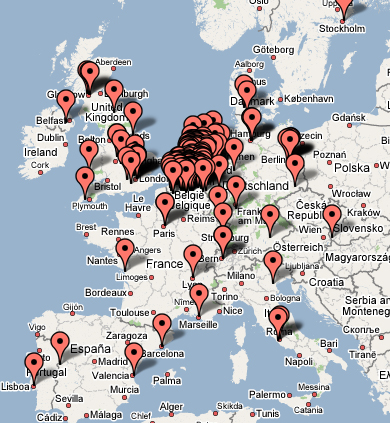
Then, go to Drop Spots, and put your drop spot on the map. So far, it seems to have been extremely popular around Belgium and the Netherlands. I suppose the authors - Brijetta Hall, Dan Phiffer and Ed Purver - might have something to do with it?
So far, there is only one drop spot in Lisbon. Hopefully this will quickly change. I'll try to participate as well.
(There isn't a single drop spot in Poland! Get to work, people!)
***
How far are we today from the first experiences with 'pervasive internet' by the folks from Blast Theory? Not very far. The gaming industry is getting all happy, there are new initiatives (especially with locative media, but not only - see this absolutely amazing site with pretty much everything you thought was possible already cataloged). But one can feel all this is still very young. Artists don't really know what to do of all these possibilities. It seems like the world is suddenly too large, not too small. And so these are small experiments for something that, I think, will be much more impressive, overwhelming, and deep-going than anything we see around today. Are you as curious as I am?
Tuesday, November 14, 2006
Layers
 Of course, of course. This is not what it seems.
This is not a concrete column. This is not graffiti. This is something entirely different. It is a picture, a photo of graffiti. It is printed on dibond, the type of aluminum that is used for traffic signs, for example. And these metal sheets are then screwed onto a plywood construction. And all this is put in a different, non-street setting (in this case, the «lovely Dicken's Library of the Mary Ward House, Bloomsbury, London», but in another, more gallery-like setting, which make it seem much poorer, almost as if it were a strictly site-specific installation).
But what is striking about this is that it is exactly what it seems - a dislocated object, a rupture in reality, an addition that questions its context. In that sense, it is correct to say this is a column with graffiti. Because here, in this space, that is what works, what creates the tension. And then, all the other levels come into play, in this sort of a hide-and-seek of «objectiveness». It all stops somewhere, because it is a self-commenting (self-referential, if you like) convention. It plays on the very fact that it's a fake. And that it is still incredibly near to reality. So near, the showing fragments of plywood actually seem glued onto the concrete pillar.
The fact that the installation is in a library seems crucial (no matter why it actually got there). It speaks volumes about what we are, who we are. Our «means of expression» and aesthetic values and the gut need for destruction (or is this just me?). At the same time, it is a taming object. It tames the defying attitude of the original by turning it into a slick, clean, savvy copy of itself. Now, this is the pillar of knowledge. Of civilization. Of us. It is what sustains - or what makes us believe it sustains the heavy walls of our libraries. And if we ridicule it for being a fake structure, we might just bee too confident in our own walls. Underestimating the actual proximity of the object, and the image.
Kristin Posehn, Replicant (2005-2006)
Technorati:
Sunday, November 12, 2006
Magdalena Jetelová. How much should we know?
See this>
 These are powerful images. Dark, quite genuine in their landartishness, in their hands-on approach to the material. No gimmicking with the pictures here, just plain, gloomy black-and-white pulp.
My recent lectures, concerning Shakespeare, his work and times, put these images in a great perspective. What is the disappearance of the battleground? And the rupture between violence and human territory? Is it about the transmitting of the violence as a value, from generation to generation? An ever-available tool? Then the battleground disappears, since war becomes a state of mind rather than an act, which is but its realization. It is the possibility of all wars against evil, be it another culture ("barbarians" means "the foreign ones") or another, more sophisticated concept required to execute the inherited right to violence ("war on terror", of course...). So the battleground disappears, and there is a rupture between violence and human territory - because it isn't about the land any more. It is about identity. About preserving what is mine, because it is mine, and because it is what it is and is in danger of becoming what it is not. Suddenly, seen from this point of view, war is everywhere. It is unbearably flexible. It becomes this dark, black mass that is there.
Then there is another level. Atlantic Wall is the title of the series of pictures by Czech-born artist Magdalena Jetelová. The Atlantic Wall, (ever heard of the Siegfried Line?), were huge fortifications made by Hitler during WW2 along the coast of the Atlantic. What does that knowledge change? How different is the spectator's position? Now go a step further in the mythological aspects of the Atlantic Wall. And now, go for an informed review. How does your response to the work change as you discover the various layer? Does it necessarily get «better»? You don't need a spoiler to make it a spoiler. In this particular case, the Atlantic Wall looked at with all the info, seems like a mere illustration to a book. A beautiful illustration, but not more. It is very difficult to forget. Go back to all this Shakespeare, which from this perspective can seem like naive babbling of an ignorant.
Among Jetelová's many great projects, one of the most powerful ones is the Domestication of a Pyramid (to see more pics, on her site go to global-pyramids, then click on pyramid corners).


Once again, my silly question: How much should we know? In this case, I preferred to remain innocent and not inquire. After all, once I know, I cannot unknow, can I?

 These are powerful images. Dark, quite genuine in their landartishness, in their hands-on approach to the material. No gimmicking with the pictures here, just plain, gloomy black-and-white pulp.
My recent lectures, concerning Shakespeare, his work and times, put these images in a great perspective. What is the disappearance of the battleground? And the rupture between violence and human territory? Is it about the transmitting of the violence as a value, from generation to generation? An ever-available tool? Then the battleground disappears, since war becomes a state of mind rather than an act, which is but its realization. It is the possibility of all wars against evil, be it another culture ("barbarians" means "the foreign ones") or another, more sophisticated concept required to execute the inherited right to violence ("war on terror", of course...). So the battleground disappears, and there is a rupture between violence and human territory - because it isn't about the land any more. It is about identity. About preserving what is mine, because it is mine, and because it is what it is and is in danger of becoming what it is not. Suddenly, seen from this point of view, war is everywhere. It is unbearably flexible. It becomes this dark, black mass that is there.
Then there is another level. Atlantic Wall is the title of the series of pictures by Czech-born artist Magdalena Jetelová. The Atlantic Wall, (ever heard of the Siegfried Line?), were huge fortifications made by Hitler during WW2 along the coast of the Atlantic. What does that knowledge change? How different is the spectator's position? Now go a step further in the mythological aspects of the Atlantic Wall. And now, go for an informed review. How does your response to the work change as you discover the various layer? Does it necessarily get «better»? You don't need a spoiler to make it a spoiler. In this particular case, the Atlantic Wall looked at with all the info, seems like a mere illustration to a book. A beautiful illustration, but not more. It is very difficult to forget. Go back to all this Shakespeare, which from this perspective can seem like naive babbling of an ignorant.
Among Jetelová's many great projects, one of the most powerful ones is the Domestication of a Pyramid (to see more pics, on her site go to global-pyramids, then click on pyramid corners).


Once again, my silly question: How much should we know? In this case, I preferred to remain innocent and not inquire. After all, once I know, I cannot unknow, can I?
Technorati:
Wednesday, November 08, 2006

Monday, November 06, 2006
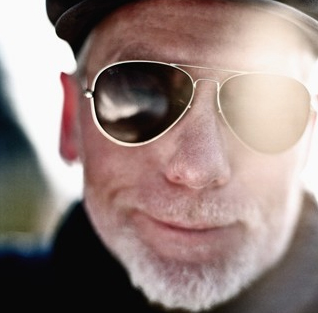
The Thought Project by Simon Hogsberg is very close to the spirit of Sophie Calle, with a slight postsecret twist. Here, too, the idea is simple: ask strangers what they were thinking at the very moment you stopped them. What impresses is the quality of the answers. It seems everyone here is either a writer or a character in a book. That is the impression I have gotten when (rarely) I had the chance to see/read Sophie Calle's work. How can the world be so filled with these amazing characters, these wild thinkers, these witty artistes... Don't get me wrong - not necessarily complex, deep thinkers. But... good people. Ben Harper asks Where'd all the good people go. To the Thought Project.
Then again, Hogsberg interviewed 150 strangers. And on the web page have 55 of them speaking. How was the choice made? In this case, isn't art the sort of science which can allow itself to be subjective, to be flawed, to be partisan? Don't we deserve some hope?
Technorati:
Thursday, November 02, 2006


Wednesday, November 01, 2006
Two more pics of Cabrita Reis + bonus

(part 1 here)
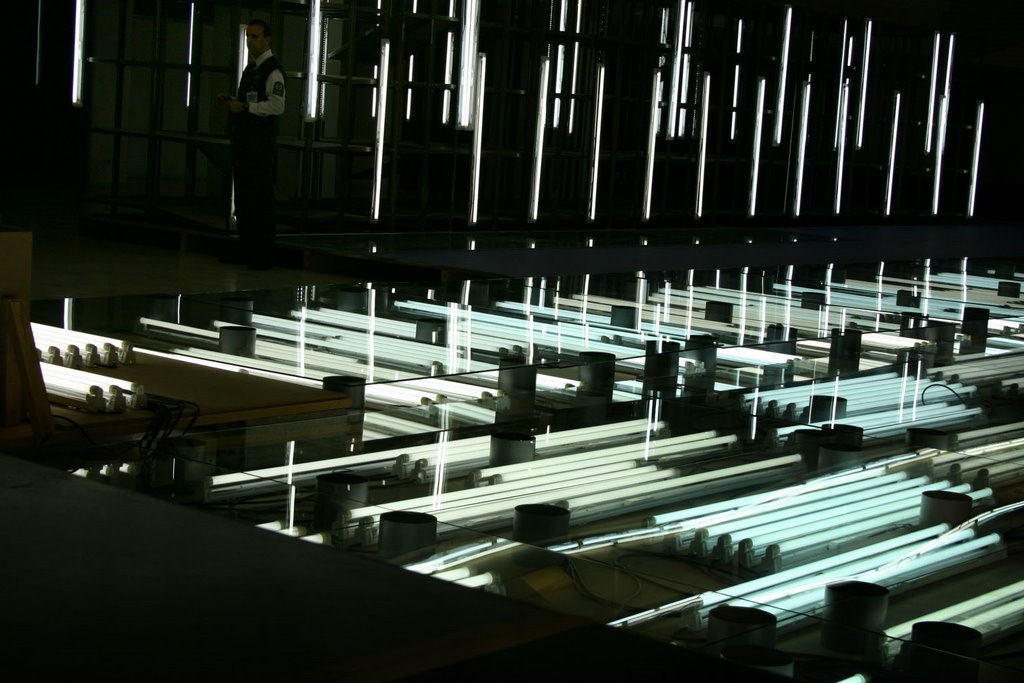
It is constructed. It is not freely distributed. It has a structure. It is the structure it has. The lights have rhythm. The lights are the chaotic order that sustains. They... some are covered with glass. Like a mirror of water. But their transparency doesn't support. Is it protected by those tables? Can we sit on the tables? And what about the guard? Does the guard know he is performing? I suppose so - both him and his colleague try hiding every time I take a picture. What is this light for? What lack of purpose? Who can I ask? Can I ask? Look at this red, look at this brown, look at this gray. Does it ring a bell? Does it ring? And once again: what are we shedding the light on? What foundation? What does it matter? After all, if it is THE FOUNDATION, shouldn't it matter? Those damned neon lights don't even shed the light, they produce it and let it go...
Something apparently useless, apparently stumbling, ending, losing itself, or outdating itself? Then, as long as you persist, as there is another structure, and another, as there is a view, and a point of view, and a work, a body of work, you just find yourself within it,
if you please.
And as a bonus, you get an engraving of an actor in a Japanese opera, from the wonderful exhibition of Japanese engravings, also at the Gulbenkian Foundation, only in the Library building.

Technorati:
Subscribe to:
Posts (Atom)
LinkWithin
