Until the end of January I probably won't be able to post. In the meantime, enjoy the archives and the links.

Wednesday, January 11, 2006


Tuesday, January 10, 2006
Crisis etc.

There's a huge crisis in the Portuguese Ministery of Culture, and I'm writing about the influence of the CIA on the abstract art of the 70's. Escapism?
Francois Lefranc, Escapism (2001)
Monday, January 09, 2006
Abstract art's secret agents
 Sam Francis, “Untitled” (ca. 1988-89)
Reposting can really be a good thing.
In 2003 Mark Vallen, the author of one of the most conservative contemporary art blogs I know, wrote a review of a book called The Cultural Cold War: The CIA and the World of Arts and Letters
 . Because of a recent exhibition of Sam Francis' works (mind you, Mark Vallen despises abstract painting), he reposted the text. Here are some fragments:
(...)during the height of the Cold War in the 1950's, the CIA secretly promoted abstract expressionism as a means of discrediting the socialist realism of the Soviet Union.(...)The spy agency created and staffed an international institution they named the Congress for Cultural Freedom(CCF,) and from 1950 to 1967 (when the front group was at last exposed as a CIA operation,) the spook endowment had secretly bankrolled the abstract expressionist movement with untold millions of dollars. (...) The CIA orchestrated the publication of a major article on Jackson Pollock in LIFE Magazine declaring him "the shining new phenomenon of American art," and the "greatest living artist."(...) The CIA applied considerable muscle in its endeavor to support and advance the abstract expressionist movement, and in large part they were successful. Realism became passé as art critics focused on singing the praises of action painting.While this is certainly a very one-sided way of seeing things, the very fact that the CIA took such an active part in the art world is spooky. It's a classic conspiracy theory gone alternative, cynical and bewildering, as all good conspiracy theories are. Where does that put us? In the box of silly lunatics, children that are easily manipulated by anyone with money to spend on PR?
Possibly.
Nonetheless, if we read into art history a little more closely, and if we compare it to the changes in Western mentality, this apparent manipulation of the CIA is really just participating in a much bigger wave. I hope this blog shows that, contrary to what Mark Vallen would like us to believe, this wave hasn't only brought "decay and primitivism", but also many wonderful, crazy, profound, unexpected or simply - beautiful experiences. And one doesn't need to adore Sam Francis (I don't) to appreciate that.
For more on the book in question:
Sunday, January 08, 2006
Art Bar
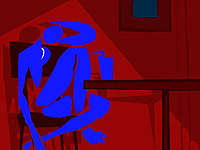
What would a real Art Bar look like? Of course, it would have nothing to do with those fancy, plushh interiors for posh people that have art director written on their business cards. It would have to be a place that corresponds to the very thing art is. And that wouldn't necessarily be so happy, would it?
Here's an attempt at imagining what a real Art Bar would look like. The 2002 work is a funny, light, and at times fairly sophisticated art amateur's inside joke, by Steve Whitehouse (and the Petrie Lounge).
The site has several other little gems, like this DaVinci Blues (1999 Flash animation that still looks fresh!), also by Steve Whitehouse.
Technorati:
Saturday, January 07, 2006
Duchamp, Urinals, and the Press

Yes, Duchamp's Fountain is safe. It was attacked by an old man with a hammer, but without success. Only some pieces of porcelain were chipped away. The porcelain seems to be of good quality.
The author of the act considers them performance art. Maybe in an act of revenge, the police wouldn't reveal his name - although we know it's Pierre Pinoncelli, as this wasn't his first act of performance art with this piece - in 1993 he peed into it (and I think he also tried hitting it with a hammer).
The act itself isn't particularly original. The fact that Duchamp disapproved of museums could be an argument, but then of course, he tried, unseccessfuly, to put Fountain in an exhibition. Is messing with other people's work bad? Using other people's works for the creation of new ones is an entire tradition. A few years ago Maurizio Cattelan stole another artist's (Paul de Reus's) entire exhibition and put it as his own (and had troubles with the police because of that), Robert Rauschenberg erased drawings by De Kooning, etc, etc...
I have no problem seeing both a piece of art and a crime in such an event. I don't see why these two should be incompatible.
There is another interesting thing about the recent art attack. The way it was described by the media. Comapre the title in USA Today: "Dada artist accused of vandalizing Duchamp piece" with the one in The Independent: "Protester tries to chip away at the reputation of Duchamp's urinal". The latter refers to the artwork as to "the urinal", without even giving its title! Fortunately, other sources of information are available: the Polish Gazeta Wyborcza writes about the object's history, Le Monde has the longest and by far the most comprehensive article, citing the perpetrator/artist ("It was going to have a miserable existance...it was better to end it using a hammer"), and even mentions a rarely mentioned fact: the urinal is not the original Fountain, but one of the eight copies (??) that were made by the artist in 1964 (!!!), since the original was "lost" in 1917.
PS. According to one commentator, the dadaists made an exhibition in the 1920's where every visitor received a hammer, thus allowing her to participate in the art...
Technorati:
Friday, January 06, 2006
Conceptual or not conceptual?
Photosynthesis Robot, by Amy Franceschini and Michael Swaine of Futurefarmers, is a possible perpetual motion machine driven by phototropism - the movement of plants towards the direction of the sun. The motion of the plants upon this four wheeled vehicle would propel slowly over a period of time.

I've been working with a group of artists on an idea not too distant from this, with one great difference: our project is not conceptual (sorry, can't reveal details for now). If it comes to life, it will be a highly complicated and high-tech work, nothing even similar to what I've been doing so far. And it costs. A lot. We're now fighting for funding. The question is: is it really worth creating "real things", if a "dummy" does the job? I mean, isn't that just the cutest thing in the world? Do we need to need more? Or maybe "doing the job" is actually hiding the possible diversity of such "jobs"... I just wish we came up with this simple witty idea instead of moving into heavy artillery.
Thanks Ivan Franco at YDreams for the link, and to we-make-money-not-art for the discovery.
Technorati:
Wednesday, January 04, 2006
Art of(f) the Edge

The internet "intellectual site" Edge has recently published the answers to its Question of the Year. The question this year was "What is Your Dangerous Idea?" The answers came from a range of intellectuals, 117 of them to be precise. Most of them are physicists or psychologists, many scientists from other areas, a few writers. And three (non-writer) artists. Make that four - I forgot Michael "Nez" Lesmith, ex-member of The Monkees, who writes that according to him "Existence is Non-Time, Non-Sequential, and Non-Objective". (I'm glad - and somewhat scared - to know that.) As for the other three artists... The first one to appear is Richard Foreman, declaring that "Radicalized relativity" is his dangerous idea:
In my area of the arts and humanities, the most dangerous idea (and the one under who's influence I have operated throughout my artistic life) is the complete relativity of all positions and styles of procedure. The notion that there are no "absolutes" in art — and in the modern era, each valuable effort has been, in one way or another, the highlighting and glorification of elements previous [I think it should be "previously" - Vvoi] "off limits" and rejected by the previous "classical" style.This rhetoric is so old I think it isn't really worth spending too much time on its critique (I've been writing about the issues and problems of the avant garde quite often anyway). Suffice it to say we all know there are no "absolutes", until we build them. And Foreman's theater has built such an absolute out of a particular stage language, a very consistent and not at all "off limits" one, at least not if by the term one means something innovative.
The second artist to answer the question is "famous landscape painter" April Gornik. And she makes an interesting remark:
The exact effect of art can't be controlled or fully anticipatedThis is indeed interesting, and every artist must have had this experience - the work lives its own life. It isn't quite what I would call a revolutionary insight, but it is probably something new to many amateurs (and amateur amateurs) of art.
Great art makes itself vulnerable to interpretation, which is one reason that it keeps being stimulating and fascinating for generations. The problem inherent in this is that art could inspire malevolent behavior, as per the notion popularly expressed by A Clockwork Orange. When I was young, aspiring to be a conceptual artist, it disturbed me greatly that I couldn't control the interpretation of my work. When I began painting, it was even worse; even I wasn't completely sure of what my art meant. That seemed dangerous for me, personally, at that time. I gradually came not only to respect the complexity and inscrutability of painting and art, but to see how it empowers the object. I believe that works of art are animated by their creators, and remain able to generate thoughts, feelings, responses. However, the fact is that the exact effect of art can't be controlled or fully anticipated.
Finally, we have one of the "art starlets of the 90's", Eric Fischl. I do not particularly appreciate his work, but here is a thought of his that might sound intriguing:
(...) Vermeer puts me into what had been [his subject's] condition of uncertainty. All I can do is wonder and wait. This makes me think about how not knowing is so important. Not knowing makes the world large and uncertain and our survival tenuous. It is a mystery why humans roam and still more a mystery why we still need to feel so connected to the place we have left. The not knowing causes such profound anxiety it, in turn, spawns creativity. The impetus for this creativity is empowerment. Our gadgets, gizmoes, networks of transportation and communication, have all been developed either to explore, utilize or master the unknown territory.What should I make of this? If you happen to have no background in philosophy, you might be impressed. The problem is, right next to this answer are more than a hundred answers that prove it wrong. They are ideas and reflections that put us back into a state of uncertainty, which, it is true, "spawns creativity", demanding new answers, new questions, new ways of touching.
If the unknown becomes known, and is not replaced with a new unknown, if the farther we reach outward is connected only to how fast we can bring it home, if the time between not knowing and knowing becomes too small, creativity will be daunted. And so I worry, if we bring the universe more completely, more effortlessly, into our homes will there be less reason to leave them?
Maybe, just maybe, the artists are supposed to be the ones touching, and not reflecting. And that would be the reason for such (I'm sorry) lame answers. My point is not that artists are stupid though. That they express, but are bad at analyzing. Many proofs have been giving of how false this statement is. Rather, I wonder - weren't the artists supposed to be the ones with dangerous ideas? The revolutionaries? The inventors of new worlds?
Here's an idea: they still might be. But nobody really cares, because artists live in a parallel world. Even the intellectual elites have no idea who can be an (intellectual, not just "intuitive" !) challenge for them. Who can be a partner in a crazy conversation about the future.
The good news is, no Hollywood stars even got a chance to answer the question. The bad - if the artists keep on answering so badly, or so quietly, they're bound to disappear, too. Without the comforting entertainment-style check...

pictures by April Gornik - Field and Storm (2003) and Storm at Sea (2005)
Technorati:
Monday, January 02, 2006
Fluffy crazy sculpting
 Botanica Beluosa - Monstrous Botany - soft sculpture ("Fabric Sculpture Installation ") by Martha Sue Harris
(via)
Thursday, December 29, 2005
Art Games

The answer isn't quite as obvious as one might think. artificial.dk now has a section about art games, or to put it more correctly - video games made by artists. How is that for a pompous way of promoting entertainment, giving it the special "art" status? Of course, some of the works are actually quite far from what one could call a game see, for instance, in the featured selection art games several works are really "hacked" games, made impossible to play or turning the concept of "game" meaningless. The work might be interesting, but isn't calling it a "game" just a pretensious way of promoting "alternativity"?
On the other hand, many art games seem to be just plain games, i.e. entertainment, under an artsy cover. They get you hooked just the same, and the esthetic aspect seems to vanish in the competitive haze. That's what happened to me with arteroids, a game I linked to some time ago. (I even clearly called it a "game", suggesting I don't quite feel arteroids are as "artsy" as its creator Jim Andrews wishes to see them)
The Intruder by Natalie Bookchin is another case. Here is a narrated story, accompanied by several "games", some of which are playable, others, well, symbolic or rather, playing on the idea of playing. It has a low-fi, underground feel to it that makes it at once appealing and irritating. Appealing, because contrary to some all-too-perfect projects, there is lots of room for us here, for changing focus, for trying to figure out a personal way of going through this. Irritating, because when I played (?) it, several times the game seemed to stop or stall. The limit of my low-fi enthusiasm appears just about here.
Technorati:
Wednesday, December 28, 2005
Universal Art?
There are some works of art that stupid people will never understand because they weren't made for stupid people. And there are a lot of stupid people. Why should anyone assume that any work of art can be reduced to the level of comprehension of a contemporary eight-year-old?- Robert Hughes (from this interview)
 Paula Rego, Girl Lifting Up Her Skirt to a Dog
 Many consider Hughes the best art critic in the world. This is his most famous and witty book about contemporary art:
In the preface, he asks: "What has our culture lost in 1980 that the avant garde had in 1890?"
And answers: "Ebullience, idealism, confidence, the belief that there was plenty of territory to explore, and above all, the sense that art, in the most disinterested and noble way, could find the necessary metaphors by which a radically changing culture could be explained to its inhabitants."
The thought is impressive. It inspires to lift one's butt and find those necessary metaphors.
But I have some doubts. The idea that art should "find metaphors", and that they are to be the "necessary metaphors", seems both scary, and distant from a modernist perspective. Conveniently, Hughes gives the example of the Eiffel Tower, which was not, however, your typical artistic enterprize of the time. Of course, today we might see it as such, but putting it as a prototype of a work of art of that era it is a projection of our today's perspective.
Doubt #2: The Van Goghs and Gaugins, and even the futurists, were not quite the "culture". They were clearly the avant garde. And with this noble classification came a marginal social status. Thus, we cannot compare today's culture to yesterday's avant garde. Those are simply different worlds. The question might be - do we still have an avant garde? Well, did the average art lover of the 1890's know what was the true, valuable avant garde (as seen by us today)? Of course, we are not just your average art lovers. We are - us. And so we know.
Does an avant garde still have any sense? Or is art so institutionalized it's impossible to see it as this fresh, new force?
I am deeply convinced that avant gardes still exist, as always, in plural, and as always, difficult to see, maybe not as much for aesthetic, as for political reasons. The avant gardes that have prevailed (that we know) seem to be those that have been taken up by some political/social movement. And those movements are yet to come. Today's social currents pick up yesterday's avant gardes and turn them into what we know - starry starry nights and eiffel towers.
Tuesday, December 27, 2005
Polite Umbrella
The Polite Umbrella, by Joo Paek, respects people’s personal space in a public area. This shrinkable umbrella enables users to morph its shape like a jellyfish in order to reduce occupied space and to increase user maneuverability.
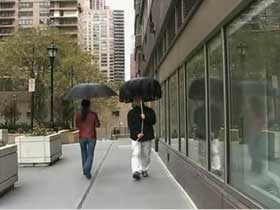
The user can adjust their umbrella by pulling a handle so that one can protect themselves from harsh winds or bumping into others. The video.
(via)
Technorati:
A Lesson in the History of Performance Art
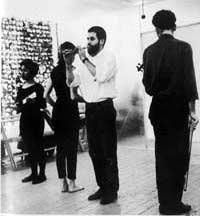
A key event in the history of modern performance was the presentation in 1959 of Allan Kaprow's 18 Happenings in 6 Parts at the Reuben Gallery. (...)
Kaprow chose the title "happening" in preference to something like theatre piece or performance because he wanted this activity to be regarded as a spontaneous event; somethink that "just happens to happen." Nevertheless, 18 Happenings, like many such events, was scripted, rehearsed, and carefully controlled. Its real departure from traditional art was not in its spontaneity, but in the sort of material it used and its manner of presentation. In his definition of a happening, Michael Kirby notes
- Marvin Carlson
Quoted from:
Monday, December 26, 2005
Performance art
Here is some good old-fashioned performance art for your viewing pleasure. It is actually a video-performance, or: performance made jsut for the video, by Hyun-Joo Min. She was born in Corea, and has been living in Germany since 1990.
uncut (1998)
In her work Hyun Joo Min is interested especially in the independent or even autonomous reality of the body which the consciousness in nearly all cases ignores, and which evades the consciousness by its becoming classified to be unimportant and insignificant. - Johannes Meinhardt
uncut (1998)
In her work Hyun Joo Min is interested especially in the independent or even autonomous reality of the body which the consciousness in nearly all cases ignores, and which evades the consciousness by its becoming classified to be unimportant and insignificant. - Johannes Meinhardt
Technorati:
Thursday, December 22, 2005
Gift
 The image above, by Matt Smear, is a Christmas gift for Grijsz. And for anyone who would like to receive it.
Technorati:
Wednesday, December 21, 2005
Mobile art

Yes, it's here. And not just some flaky flowers or christmas trees or your favorite Monet. I'm talkin' all the hypest artists you've heard about (unless you're like me, then most of them you haven't heard about). On your mobile. For the humble price of $1.99 each. Yes, this means it's US only. And yes, the artists are American or Americanish ( e.g. Jorge Naranjo, whose work is above, is of Mexican origin).
This retail art gallery for your cell phone is brought to you by Start Soma, the San Francisco gallery for emerging artists.
(via)
Technorati:

Monday, December 19, 2005

1-pixel Pac Man + Christmas card
 The smallest Pac Man ever.
The author, Alan Outten, author of the world's smallest website (with many other tiny versions of classic games), has a pretty Christmas card on his site.
And this is my favorite small piece of his.
Technorati:
Saturday, December 17, 2005
Obscene Art #3: For the Love of Flesh - Joel-Peter Witkin
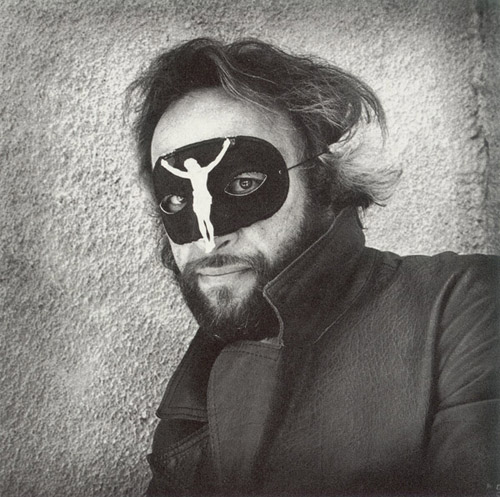
The sad thing is that more and more, we are becoming disconnected with a sense of wonder, of mystery and destiny.Joel-Peter Witkin
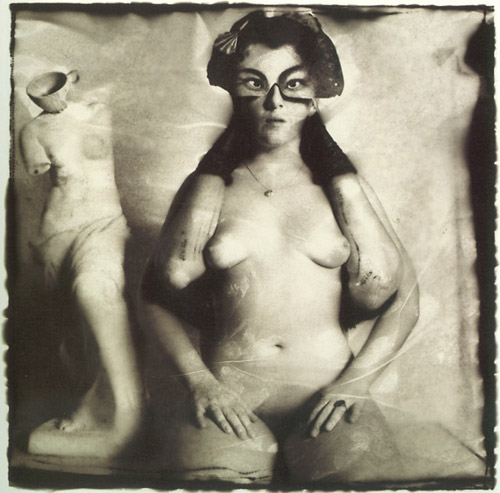
It isn't hard to think up something very deep and poetic concerning Witkin: through his imagery, we gain a greater understanding about human difference and tolerance, someone declares. Someone else seems to admire Witkin for nearly the opposite:
His arresting images show us our powerlessness in the face of madness, lust, disease and death.
The thing about Joel-Peter Witkin is that he shows people. And daringly so. The strangest people you have ever seen. In the strangest of poses. In the most surprizing situations. And, although his pictures are full (some say: overfilled) with references to art history, his merit seems to be above all related to this: showing.

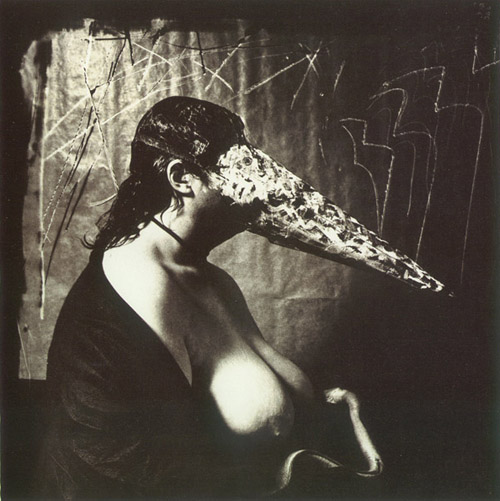 How does he find his models? Some of them in the morgues, others, from ads. Ads like this one from 1989, looking for:
Pinheads, dwarfs, giants, hunchbacks, pre-op transsexuals, bearded women, people with tails, horns, wings, reversed hands or feet, anyone born without arms, legs, eyes, breast, genitals, ears, nose, lips. All people with unusually large genitals. All manner of extreme visual perversion. Hermaphrodites and teratoids (alive and dead). Anyone bearing the wounds of Christ.(...) Anyone claiming to be God. God.
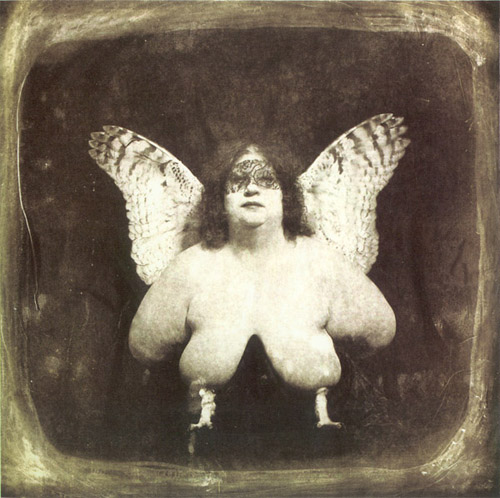
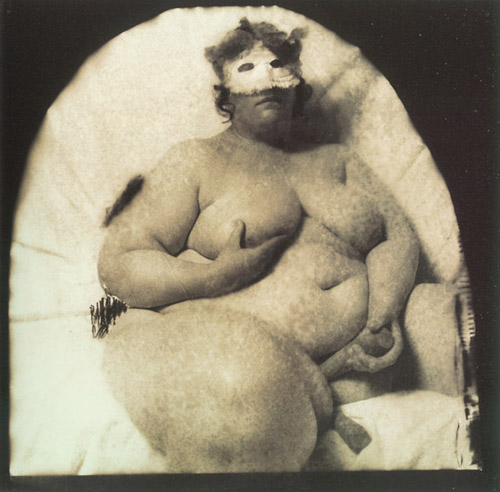
Someone states that seeing Witkin's works is like witnessing a brutal car crash. Indeed, we feel voyeuristic, as in, willing to witness obscenity. Being the good art amateurs we are, we look for justifications, just as we might look at the crash "from a distance", inquiring into the reactions of others, or the aesthetic vs. ethical aspects of the scene. We might even go so far as to declare the paintings a cry for tolerance. The question remains: how distant is this cry from the freak-shows history has known time and again? Isn't it just the curiosity of the crippled, the strange, the too-different? Seeing the world without its regular masks?
And if we are just part of a long line of curious onlookers, are we damned? As in, morally condemnable?
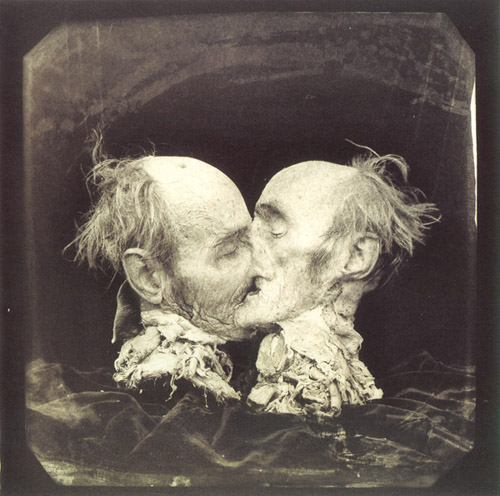 The concept of monster, which made a career during the Renaissance, comes from the Latin verb monere, to warn, and/or from the Greek root teras, meaning something both horrible and wonedrful.
Contrary to common belief, monsters weren't only associated with signs of evil events to come, but also, and quite frequently, with signs of devine power. The monster shows were often events where one would discover the many ways of divine creation. (Notice how words like "amazing" and "awesome" also have an ambiguous quality at their origin, but went the other way, becoming generally accepted as positive adjectives).
In this sense, what we see, through Joel-Peter Witkin's eyes, are monsters. They are the marvels.
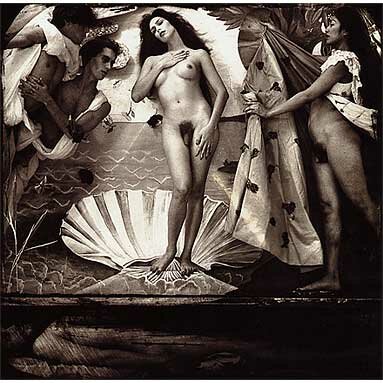 They are the graces of a wonder-ful world.
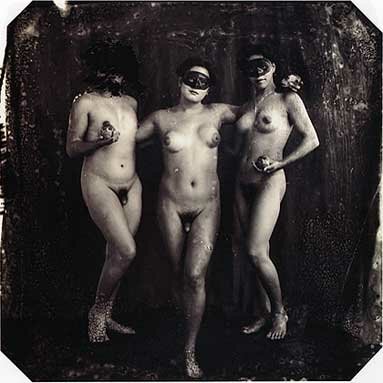 Should we believe that Witkin is genuinely preoccupied with the people he photographs? Yes, there seems to be no doubt about it. He is deeply religious, but has found a home in the esoteric side of religion. And with it comes the love for the awesome, the excentric. And a fascination for, or empathy with, the humans within this underworld. He is interested in their stories, and openly declares that his art is "not intended to reveal what the individual subject chooses to hide but instead to make the hidden qualities more meaningful."
Meaningful they become. But what is their meaning? And does it not risk turning against those he claims to defend?

One of Witkin's many critics, Cintra Wilson, writes,
The work is beautiful enough to be "real art," but it is still an intellectually camouflaged, carny peep show of the most debased and obvious water. You can put as many flowery wreaths and as much gorgeous photo technique as you want around a dead baby, and it will be art, yes, but it is still a dead baby. It is still a sideshow for the morbidly curious, regardless of how much Witkin may drone on about the deeply religious quality of his work.Then again - Francis Bacon, in that sense, did not evolve, did he?
(...) The artists I respect get more irreverent with age while, at the same time, they humanize; they lighten up, they drop the old mask, they actually start to care about things more and open up a little, laughing about things they used to take to heart as deathly serious. They evolve -- for better or worse.
(the first image is the portrait of Witkin by his wife, tattoo artist Cynthia Witkin)
Also check out one of the most recent of Witkin's albums:
Subscribe to:
Posts (Atom)
LinkWithin
